USNSJUSNSJ
Journal of Biological Science and EducationJournal of Biological Science and EducationThis literature review explores the multifaceted role of Pseudomonas syringae, a bacterium renowned for its ice-nucleating properties. Pseudomonas syringae significantly influences atmospheric processes, agriculture, and various ecosystems. These bacteria, equipped with ice nucleation proteins (INPs), facilitate ice formation at temperatures warmer than the typical freezing point, impacting weather patterns by initiating snow and hail formation. While its ice-nucleating activity can lead to frost damage in agriculture, it is also harnessed for artificial snow production. This review synthesizes findings on the bacteriums characteristics, morphology, physiology, and ecology, drawing from diverse studies. It highlights its widespread presence in various environments, including plant surfaces, water bodies, and atmospheric samples, emphasizing its adaptability and ecological significance. By employing content analysis on secondary data sources, this study provides a comprehensive understanding of Pseudomonas syringaes unique ability to mediate ice formation and its broader implications for environmental balance and biotechnological applications.
Pseudomonas syringae is a gram-negative, rod-shaped bacterium with spherical colonies that is widely distributed in various environments and plants and is known for its ice nucleation activity mediated by ice-nucleating proteins such as InaZ.Although this bacterium causes pathogenesis in a number of plant diseases, it has important ecological roles, including the formation of ice, clouds, and precipitation.Its adaptability gives it the ability to survive in a wide range of climatic conditions, and despite its high genetic variation, common strains have high ecological relevance.
Penelitian lebih lanjut perlu dilakukan untuk menginvestigasi potensi Pseudomonas syringae dalam modifikasi cuaca, khususnya dalam meningkatkan curah hujan di daerah yang mengalami kekeringan. Hal ini dapat dilakukan dengan mempelajari mekanisme molekuler yang mengatur produksi protein pembentuk es oleh bakteri, serta mengoptimalkan kondisi lingkungan untuk memaksimalkan aktivitasnya. Selain itu, penelitian perlu difokuskan pada pengembangan strategi pengendalian hayati yang efektif dan ramah lingkungan untuk mengurangi dampak negatif P. syringae pada tanaman pertanian, misalnya dengan memanfaatkan bakteriophage sebagai agen biokontrol. Terakhir, studi komparatif perlu dilakukan untuk membandingkan efektivitas berbagai strain P. syringae dalam membentuk es, serta mengidentifikasi strain-strain unggul yang dapat dimanfaatkan untuk aplikasi praktis seperti produksi salju buatan atau pendinginan industri. Penelitian-penelitian ini diharapkan dapat memberikan pemahaman yang lebih mendalam tentang peran penting P. syringae dalam ekosistem dan membuka peluang baru untuk pemanfaatannya dalam berbagai bidang.
- JENIS DAN POPULASI BAKTERI ICE NUCLEATION ACTIVE PENYEBAB LUKA BEKU PADA DAUN JERUK KEPROK SOE DI DATARAN... ejournal.unipas.ac.id/index.php/Agro/article/view/585JENIS DAN POPULASI BAKTERI ICE NUCLEATION ACTIVE PENYEBAB LUKA BEKU PADA DAUN JERUK KEPROK SOE DI DATARAN ejournal unipas ac index php Agro article view 585
- Diversity and ice nucleation activity of Pseudomonas syringae in drone-based water samples from eight... peerj.com/articles/16390Diversity and ice nucleation activity of Pseudomonas syringae in drone based water samples from eight peerj articles 16390
- Phytopathogenic Pseudomonas syringae as a Threat to Agriculture: Perspectives of a Promising Biological... doi.org/10.3390/horticulturae9060712Phytopathogenic Pseudomonas syringae as a Threat to Agriculture Perspectives of a Promising Biological doi 10 3390 horticulturae9060712
| File size | 494.07 KB |
| Pages | 9 |
| DMCA | Report |
Related /

INAISINAIS Hasil penelitian menunjukkan bahwa Madrasah Ibtidaiyah Al Ishlah Rancajaya berada di bawah naungan Kementerian Agama dan menerapkan integrasi antara pendidikanHasil penelitian menunjukkan bahwa Madrasah Ibtidaiyah Al Ishlah Rancajaya berada di bawah naungan Kementerian Agama dan menerapkan integrasi antara pendidikan

SYEKH NURJATISYEKH NURJATI Implementasi 7M meliputi pembentukan karakter, penguatan nilai keagamaan, peningkatan fasilitas, pelatihan pendidik, kesejahteraan pendidik, dan penyediaanImplementasi 7M meliputi pembentukan karakter, penguatan nilai keagamaan, peningkatan fasilitas, pelatihan pendidik, kesejahteraan pendidik, dan penyediaan

UNISMUH PALUUNISMUH PALU Pandan leaf extract (Pandanus amaryllifolius), basil leaf extract (Ocimum sanctum) and bay leaf extract (Syzygium polyanthum) can be used as natural alternativePandan leaf extract (Pandanus amaryllifolius), basil leaf extract (Ocimum sanctum) and bay leaf extract (Syzygium polyanthum) can be used as natural alternative

UMPUMP Statistical analysis using the Wilcoxon test showed a significant difference in knowledge levels before and after the intervention, with a p-value of 0.Statistical analysis using the Wilcoxon test showed a significant difference in knowledge levels before and after the intervention, with a p-value of 0.
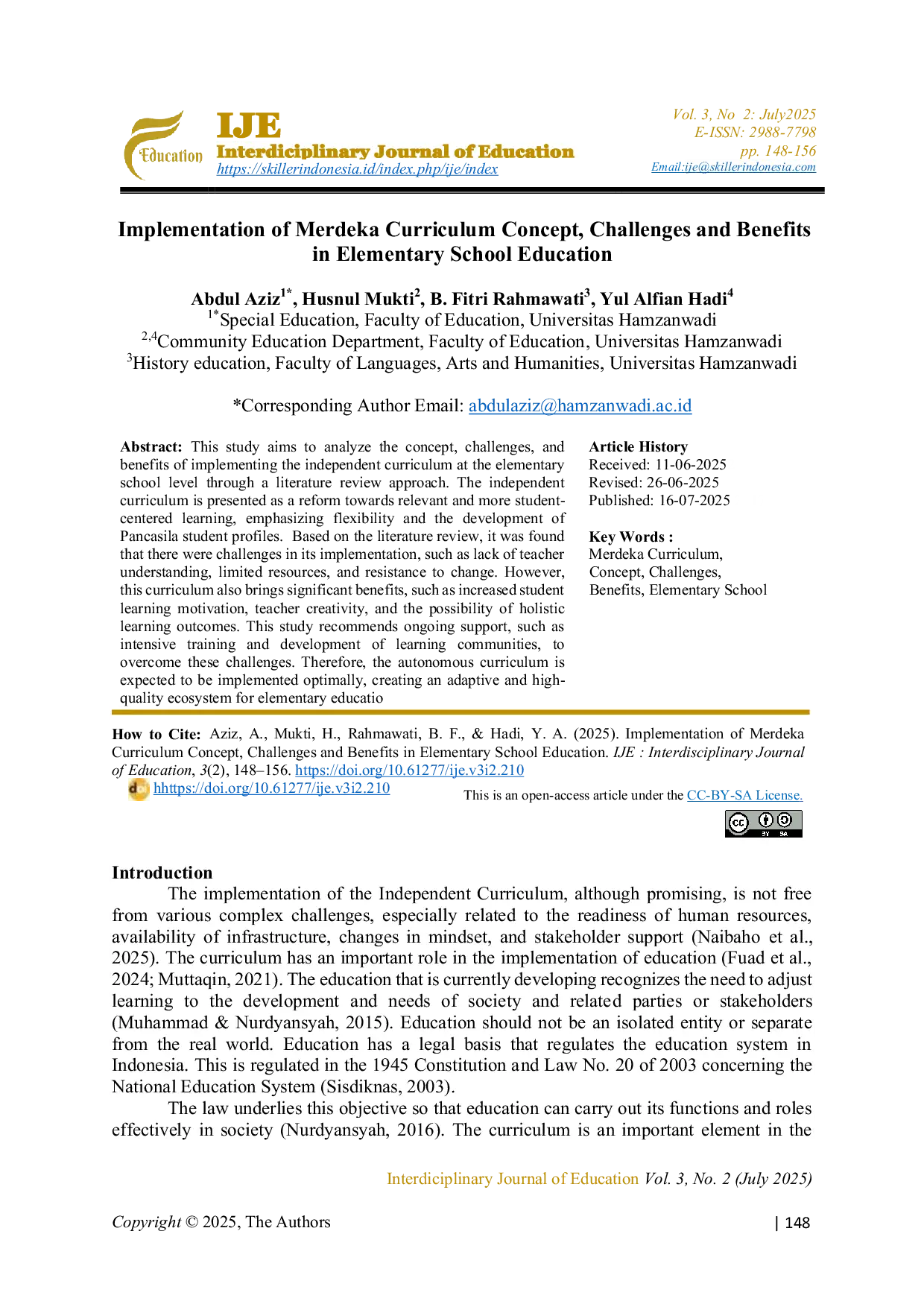
SKILLERINDONESIASKILLERINDONESIA Namun, kurikulum ini juga membawa manfaat signifikan, seperti meningkatnya motivasi belajar siswa, kreativitas guru, dan kemungkinan hasil pembelajaranNamun, kurikulum ini juga membawa manfaat signifikan, seperti meningkatnya motivasi belajar siswa, kreativitas guru, dan kemungkinan hasil pembelajaran

UNDIKMAUNDIKMA The implementation of this research was in the Tadulako University PGSD study program and the test subjects were students of the 2019/2010 class. The resultsThe implementation of this research was in the Tadulako University PGSD study program and the test subjects were students of the 2019/2010 class. The results

UNDIKMAUNDIKMA The vocabulary of 85% of children is also increased and 15% can implement a few words in daily conversation. During the teaching and learning process,The vocabulary of 85% of children is also increased and 15% can implement a few words in daily conversation. During the teaching and learning process,

SYEKH NURJATISYEKH NURJATI Implementation of learning includes several aspects, including opening lessons, delivering material, and closing lessons. In practice, the direct methodImplementation of learning includes several aspects, including opening lessons, delivering material, and closing lessons. In practice, the direct method
Useful /

JMHSAJMHSA This report describes a case of complete hydatidiform mole in a 35-year-old woman, in which diagnosis was primarily established through characteristicThis report describes a case of complete hydatidiform mole in a 35-year-old woman, in which diagnosis was primarily established through characteristic

PUBLIKASIINDONESIAPUBLIKASIINDONESIA Pengukuran dilaksanakan selama 36 hari, dari 25 September hingga 31 Oktober 2025. Metode pengumpulan data menggunakan pendekatan kuantitatif dan kualitatif,Pengukuran dilaksanakan selama 36 hari, dari 25 September hingga 31 Oktober 2025. Metode pengumpulan data menggunakan pendekatan kuantitatif dan kualitatif,

PUBLIKASIINDONESIAPUBLIKASIINDONESIA Penelitian ini menunjukkan adanya permintaan yang signifikan dan terus meningkat untuk talenta Chinese Vocational di Indonesia, yang didorong oleh hubunganPenelitian ini menunjukkan adanya permintaan yang signifikan dan terus meningkat untuk talenta Chinese Vocational di Indonesia, yang didorong oleh hubungan

USNSJUSNSJ Sampel penelitian meliputi mahasiswa pendidikan biologi angkatan 2020, 2021, 2022, dan 2023, dengan 45 mahasiswa sebagai responden. Penelitian ini menyimpulkanSampel penelitian meliputi mahasiswa pendidikan biologi angkatan 2020, 2021, 2022, dan 2023, dengan 45 mahasiswa sebagai responden. Penelitian ini menyimpulkan