UKINSTITUTEUKINSTITUTE
Journal of Psychological PerspectiveJournal of Psychological PerspectiveThis study explores the evolving role of the metaverse in education, with a particular focus on emerging trends, pedagogical applications, and the transformative potential of family-school interactions within virtual learning environments. This study examined articles from January 2000 to May 2025 using a narrative review method. The statistical population of the study includes all studies conducted on education in the metaverse, and through content analysis, research trends, patterns, geographical distribution, opportunities, and challenges of education in the metaverse were examined. Through a comprehensive review, we identify three dominant trends: (1) increasing adoption of immersive technologies in STEM and arts education, (2) growing research interest post-pandemic, particularly in North America and East Asia, and (3) the development of multi-layered educational interactions (student-teacher, peer-to-peer, and parent-school). Key applications demonstrate the metaverses capacity to enable borderless collaboration, personalized learning through AI analytics, and culturally inclusive educational experiences. The analysis reveals significant opportunities for family engagement, including real-time parental participation in learning processes and enhanced safety monitoring features. However, critical challenges emerge, including digital equity gaps (particularly in Middle Eastern and African contexts), privacy concerns, technological addiction risks, and special needs accessibility barriers. The findings suggest that while the metaverse offers innovative pathways for reimagining education, its successful integration requires addressing infrastructural limitations, developing ethical frameworks, and implementing targeted teacher and parent training programs. This review contributes to ongoing discussions about digital transformation in education by highlighting both the disruptive potential and implementation complexities of metaverse technologies in family-school ecosystems.
The metaverse presents a transformative platform for education, offering novel methods for personalized learning, global collaboration, and active family engagement.However, challenges such as the digital divide, privacy concerns, and cultural barriers hinder its widespread adoption.Successful integration requires a holistic approach that addresses technical, cultural, and societal aspects, alongside infrastructure investment and stakeholder training.
Future research should focus on designing metaverse-based educational models tailored to the infrastructural and cultural contexts of developing countries, addressing the current research bias towards developed nations. Furthermore, investigations are needed to explore the potential of AI-driven personalized learning within the metaverse, specifically how to provide intelligent feedback to parents regarding their childrens progress. Finally, studies should investigate the long-term effects of metaverse integration on the development of crucial social skills and emotional intelligence, ensuring a balanced approach that complements traditional learning methods and prioritizes holistic student development. These investigations should consider the unique needs of diverse learners, including those with disabilities, and aim to create inclusive and equitable metaverse learning environments.
- Virtual reality in language learning: a systematic review and implications for research and practice:... tandfonline.com/doi/full/10.1080/10494820.2020.1765392Virtual reality in language learning a systematic review and implications for research and practice tandfonline doi full 10 1080 10494820 2020 1765392
- A Metaverse: Taxonomy, Components, Applications, and Open Challenges | IEEE Journals & Magazine |... doi.org/10.1109/ACCESS.2021.3140175A Metaverse Taxonomy Components Applications and Open Challenges IEEE Journals Magazine doi 10 1109 ACCESS 2021 3140175
| File size | 460.42 KB |
| Pages | 8 |
| DMCA | Report |
Related /

ADI JOURNALADI JOURNAL TI secara efisien membantu siswa dalam memperoleh pengetahuan dan keterampilan bahasa Inggris melalui penggunaan sumber belajar, aplikasi pembelajaran,TI secara efisien membantu siswa dalam memperoleh pengetahuan dan keterampilan bahasa Inggris melalui penggunaan sumber belajar, aplikasi pembelajaran,

UMPPUMPP Program ini diharapkan menjadi model literasi keuangan lansia yang holistik, berkelanjutan, dan berorientasi pada kesejahteraan lahir dan batin di usiaProgram ini diharapkan menjadi model literasi keuangan lansia yang holistik, berkelanjutan, dan berorientasi pada kesejahteraan lahir dan batin di usia

BIMABERILMUBIMABERILMU Metode yang digunakan adalah pelatihan berbasis kompetensi dengan pendekatan blended learning yang mengombinasikan workshop interaktif, simulasi pelayanan,Metode yang digunakan adalah pelatihan berbasis kompetensi dengan pendekatan blended learning yang mengombinasikan workshop interaktif, simulasi pelayanan,
UKRIDAUKRIDA Penelitian ini merupakan penelitian tindakan sekolah yang menggunakan metode coaching dengan personal mastery dan team learning. Tujuan penelitian iniPenelitian ini merupakan penelitian tindakan sekolah yang menggunakan metode coaching dengan personal mastery dan team learning. Tujuan penelitian ini

BIMABERILMUBIMABERILMU Upaya kolektif dalam mengoptimalkan sumber daya lokal sebagai bahan media pembelajaran dapat menjadi alternatif efektif untuk mengatasi tantangan keterbatasanUpaya kolektif dalam mengoptimalkan sumber daya lokal sebagai bahan media pembelajaran dapat menjadi alternatif efektif untuk mengatasi tantangan keterbatasan

LITERASISAINSLITERASISAINS Selain itu, guru-guru juga diperkenalkan dengan metode pembelajaran berbaur (blended learning) dan mereka juga dilatih untuk mendesain bahan ajar digitalSelain itu, guru-guru juga diperkenalkan dengan metode pembelajaran berbaur (blended learning) dan mereka juga dilatih untuk mendesain bahan ajar digital
UIN SGDUIN SGD Hasil menunjukkan hambatan seperti infrastruktur laboratorium yang tidak memadai, guru tidak siap, kurangnya alat dan bahan, fasilitas pendukung terbatas,Hasil menunjukkan hambatan seperti infrastruktur laboratorium yang tidak memadai, guru tidak siap, kurangnya alat dan bahan, fasilitas pendukung terbatas,
UMUM Teknik yang digunakan dalam pengumpulan data melalui penyebaran angket. Angket di validasi terlebih dahulu oleh ahli media dan ahli materi sebelum di ujicobakanTeknik yang digunakan dalam pengumpulan data melalui penyebaran angket. Angket di validasi terlebih dahulu oleh ahli media dan ahli materi sebelum di ujicobakan
Useful /

JOMPARNDJOMPARND Namun, kulit padi sebenarnya mengandung banyak energi dan bahan berguna seperti silika, menjadikannya pilihan yang baik sebagai bahan bakar terbarukan.Namun, kulit padi sebenarnya mengandung banyak energi dan bahan berguna seperti silika, menjadikannya pilihan yang baik sebagai bahan bakar terbarukan.
UMUM Tujuan penelitian ini adalah untuk mengungkap pengaruh aplikasi canva terhadap kreativitas guru penggerak. Penelitian ini menggunakan pendekatan kuantitatifTujuan penelitian ini adalah untuk mengungkap pengaruh aplikasi canva terhadap kreativitas guru penggerak. Penelitian ini menggunakan pendekatan kuantitatif
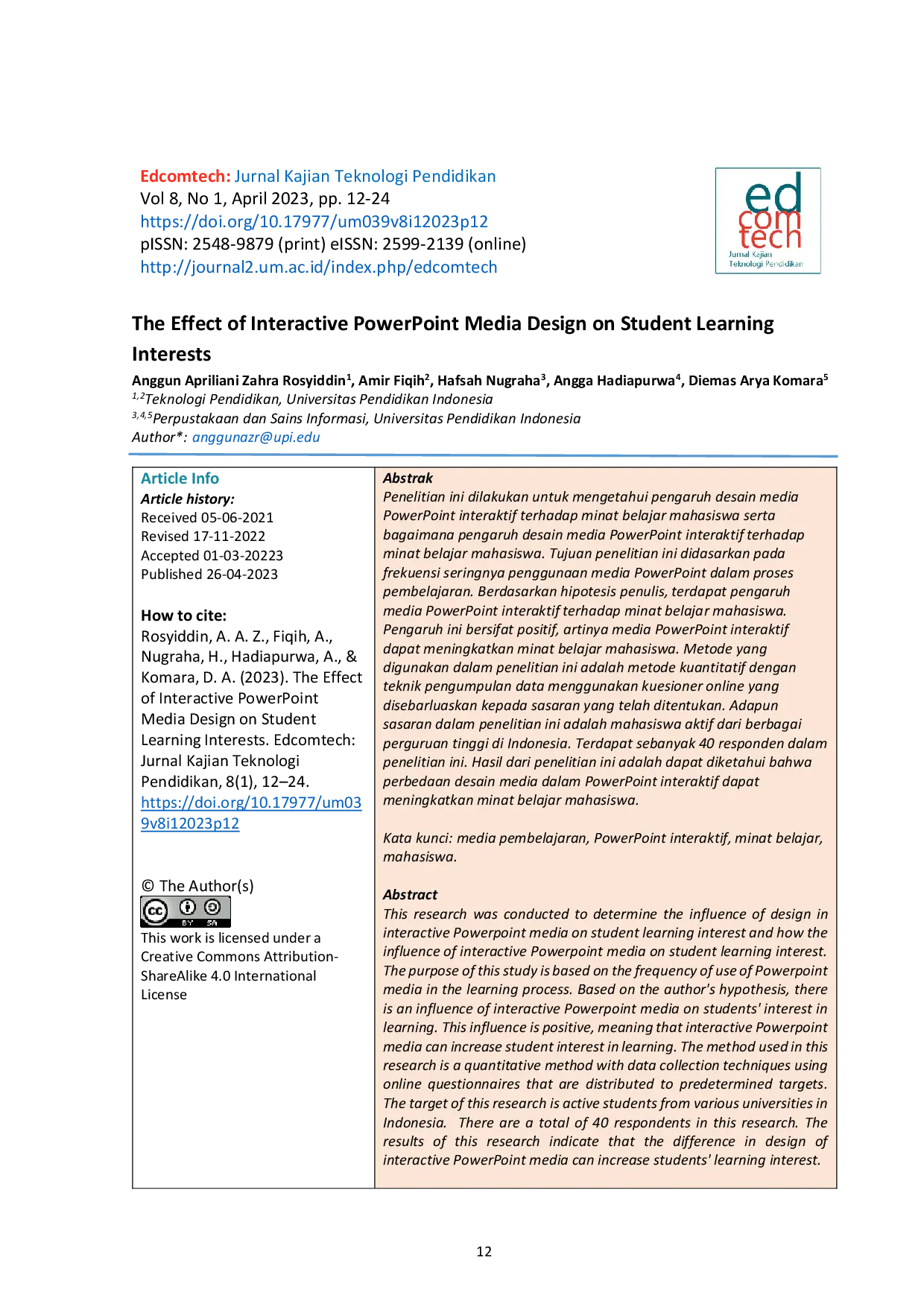
UMUM Hasil dari penelitian ini adalah dapat diketahui bahwa perbedaan desain media dalam PowerPoint interaktif dapat meningkatkan minat belajar mahasiswa. BerdasarkanHasil dari penelitian ini adalah dapat diketahui bahwa perbedaan desain media dalam PowerPoint interaktif dapat meningkatkan minat belajar mahasiswa. Berdasarkan

UMUM Learning Management System (LMS) merupakan alternatif pembelajaran yang memungkinkan guru dan siswa berinteraksi secara sistematis. Penelitian ini bertujuanLearning Management System (LMS) merupakan alternatif pembelajaran yang memungkinkan guru dan siswa berinteraksi secara sistematis. Penelitian ini bertujuan