KHATECKHATEC
Praxis and Pedagogy in English Language EducationPraxis and Pedagogy in English Language EducationThe growing emphasis on 21st-century skills in Indonesian education underscores the importance of fostering critical thinking among university students. While curriculum reforms have been implemented, concerns remain about the effectiveness of these changes in developing students critical thinking abilities, particularly in the context of argumentative writing. This study investigated the level of critical thinking demonstrated by 33 fourth-semester English Education students at UIN Raden Intan Lampung in their argumentative essays. Employing a descriptive-quantitative research design with content analysis, the study utilized the Marguerite and Ennis (1993) rubric to assess students performance across six aspects of critical thinking: focus, supporting reasons, reasoning, organization, conventions, and integration. Findings revealed that students generally performed well in focus, supporting reasons, organization, and conventions, exhibiting well-developed proficiency in these areas. However, reasoning emerged as a significant area of weakness, with a substantial portion of students demonstrating only developing-level skills. The overall average score indicated a well-developed level of critical thinking, yet the persistent challenges in reasoning highlight the need for targeted pedagogical interventions that specifically address this crucial aspect. This study provides valuable insights for educators seeking to enhance critical thinking instruction and assessment within Indonesian universities, emphasizing the importance of fostering not only technical writing skills but also the deeper cognitive processes that underpin genuine critical inquiry. The results contribute to the ongoing evaluation of curricular reforms and inform future efforts to equip Indonesian students with the critical thinking skills necessary for success in the 21st century.
The study revealed that Indonesian university students generally demonstrate well-developed critical thinking skills in argumentative essays, particularly in focus, supporting reasons, organization, and conventions.However, a notable weakness exists in the area of reasoning, indicating a need for targeted pedagogical interventions.These findings contribute to the ongoing evaluation of curriculum reforms and highlight the importance of fostering deeper cognitive processes alongside technical writing skills.
Further research should investigate effective pedagogical strategies to specifically enhance reasoning skills among Indonesian university students, potentially through the integration of explicit instruction in logical fallacies and argumentation techniques. Additionally, studies could explore the relationship between digital literacy and critical thinking in argumentative writing, examining how students evaluate online sources and construct evidence-based arguments in a digital environment. Finally, longitudinal studies tracking the development of critical thinking skills over time are needed to assess the long-term impact of educational interventions and inform curriculum development, ensuring that Indonesian students are equipped with the essential skills for success in the 21st century. These investigations should consider the unique cultural and educational context of Indonesia to develop tailored approaches that effectively promote critical thinking abilities.
- An Approach for Embedding Critical Thinking in Second Language Paragraph Writing - Chason - 2017 - TESOL... onlinelibrary.wiley.com/doi/10.1002/tesj.288An Approach for Embedding Critical Thinking in Second Language Paragraph Writing Chason 2017 TESOL onlinelibrary wiley doi 10 1002 tesj 288
- Can Thinking be Taught? Linking Critical Thinking and Writing in an EFL Context - Sandhya Rao Mehta,... journals.sagepub.com/doi/10.1177/0033688214555356Can Thinking be Taught Linking Critical Thinking and Writing in an EFL Context Sandhya Rao Mehta journals sagepub doi 10 1177 0033688214555356
- World Journal of English Language. world journal english language issn peer reviewed open access published... doi.org/10.5430/wjel.v12n3p126World Journal of English Language world journal english language issn peer reviewed open access published doi 10 5430 wjel v12n3p126
- How argumentative writing stifles open-mindedness - James Southworth, 2021. writing stifles open mindedness... journals.sagepub.com/doi/10.1177/1474022220903426How argumentative writing stifles open mindedness James Southworth 2021 writing stifles open mindedness journals sagepub doi 10 1177 1474022220903426
- Components of Education 4.0 in 21st Century Skills Frameworks: Systematic Review. components education... mdpi.com/2071-1050/14/3/1493Components of Education 4 0 in 21st Century Skills Frameworks Systematic Review components education mdpi 2071 1050 14 3 1493
| File size | 555.23 KB |
| Pages | 10 |
| DMCA | Report |
Related /

STIEPEMUDASTIEPEMUDA The research findings indicate that Gadjah Gold Store Bali Branch should continuously update product designs to align with market trends and offer customizationThe research findings indicate that Gadjah Gold Store Bali Branch should continuously update product designs to align with market trends and offer customization

STIEPEMUDASTIEPEMUDA Penelitian difokuskan pada tiga kedai kopi mikro di tiga kota dengan populasi kedai kopi terbanyak di Bali; Courtside Bre (Denpasar), Pesona by The BayPenelitian difokuskan pada tiga kedai kopi mikro di tiga kota dengan populasi kedai kopi terbanyak di Bali; Courtside Bre (Denpasar), Pesona by The Bay

STIEPEMUDASTIEPEMUDA Penelitian ini merekomendasikan inovasi berkelanjutan dalam konten digital dan penawaran produk untuk mempertahankan daya saing. Selain itu, penting untukPenelitian ini merekomendasikan inovasi berkelanjutan dalam konten digital dan penawaran produk untuk mempertahankan daya saing. Selain itu, penting untuk

UMPOUMPO Kurikulum dan layanan bagi siswa berbakat dan bertalenta di Madrasah Ibtidaiyah menekankan kebutuhan akan kurikulum menantang, kurikulum diferensiasi,Kurikulum dan layanan bagi siswa berbakat dan bertalenta di Madrasah Ibtidaiyah menekankan kebutuhan akan kurikulum menantang, kurikulum diferensiasi,

UMPOUMPO Berbagai dimensi atau variabel yang dapat dieksplorasi dalam penelitian tentang Indeks Kesalehan Sosial meliputi. 1) kegiatan ibadah individu, 2) pengetahuanBerbagai dimensi atau variabel yang dapat dieksplorasi dalam penelitian tentang Indeks Kesalehan Sosial meliputi. 1) kegiatan ibadah individu, 2) pengetahuan
SINOMICSJOURNALSINOMICSJOURNAL The implementation of artificial intelligence (AI) in financial crisis early warning systems is proven to improve the effectiveness of risk detection andThe implementation of artificial intelligence (AI) in financial crisis early warning systems is proven to improve the effectiveness of risk detection and
SINOMICSJOURNALSINOMICSJOURNAL Penerbitan Undang-Undang Kesehatan merupakan salah satu langkah signifikan dalam memperkuat jaminan hak asasi manusia di bidang pelayanan publik, khususnyaPenerbitan Undang-Undang Kesehatan merupakan salah satu langkah signifikan dalam memperkuat jaminan hak asasi manusia di bidang pelayanan publik, khususnya
SINOMICSJOURNALSINOMICSJOURNAL This study uses a comparative qualitative method of analysis by comparing documents published in developed and developing countries. The results of thisThis study uses a comparative qualitative method of analysis by comparing documents published in developed and developing countries. The results of this
Useful /
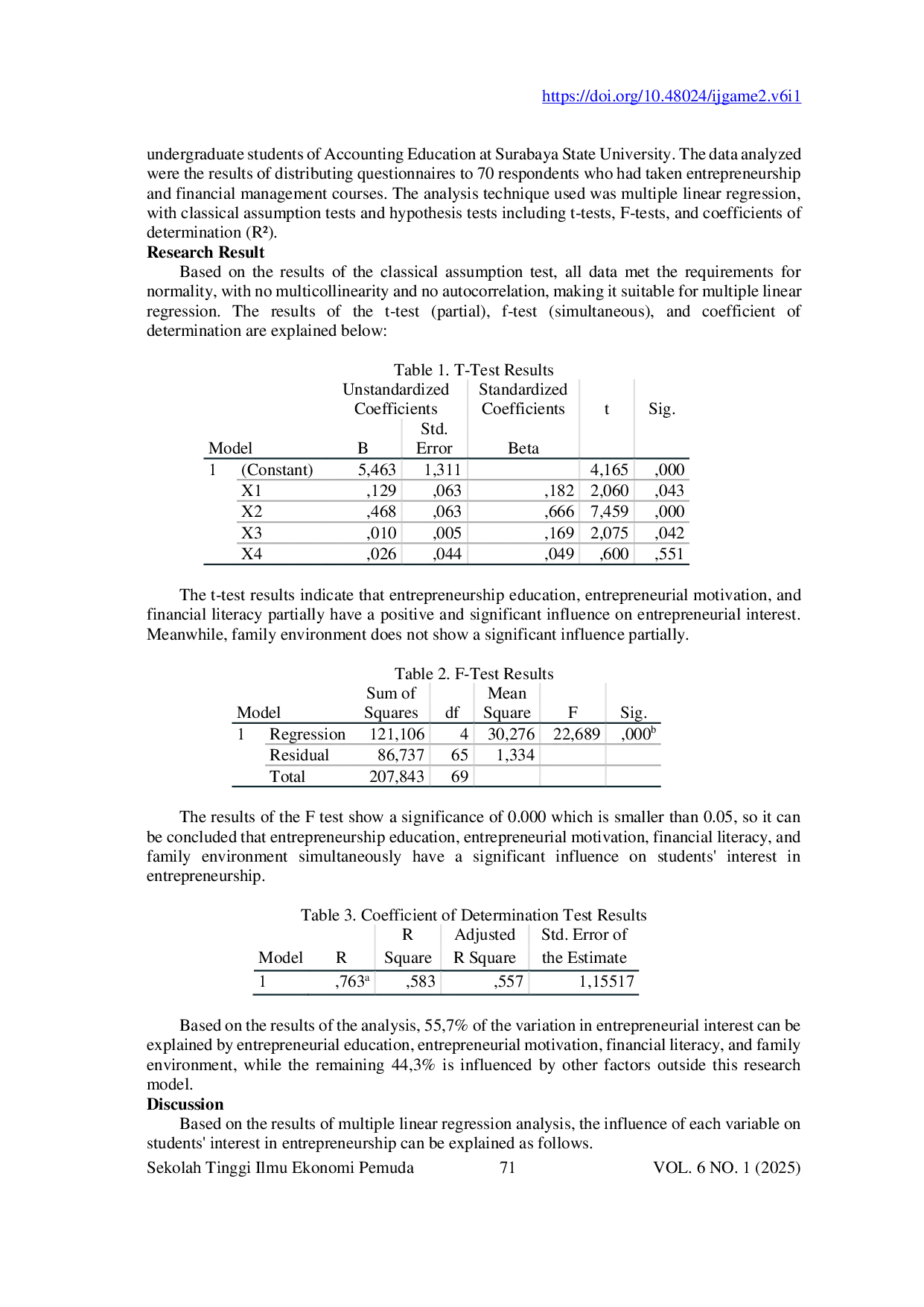
STIEPEMUDASTIEPEMUDA The background of this study is the low entrepreneurship ratio in Indonesia and the high unemployment rate among college graduates. The method used wasThe background of this study is the low entrepreneurship ratio in Indonesia and the high unemployment rate among college graduates. The method used was

STIEPEMUDASTIEPEMUDA The data collection technique used a questionnaire. The data analysis technique used the SEM-PLS test with the help of the SmartPLS 4. 9. 2 software program.The data collection technique used a questionnaire. The data analysis technique used the SEM-PLS test with the help of the SmartPLS 4. 9. 2 software program.

STAI TBHSTAI TBH Hasil penelitian menunjukkan bahwa penerapan model pembelajaran kooperatif STAD memberikan dampak positif, seperti meningkatnya interaksi sosial antarHasil penelitian menunjukkan bahwa penerapan model pembelajaran kooperatif STAD memberikan dampak positif, seperti meningkatnya interaksi sosial antar

UAIUAI Penelitian dengan pendekatan kualitatif. Pengumpulan data diperoleh dari studi empiris dan literatur dengan mendokumentasikan dan mereview semua artikelPenelitian dengan pendekatan kualitatif. Pengumpulan data diperoleh dari studi empiris dan literatur dengan mendokumentasikan dan mereview semua artikel