UMBUMB
SINERGISINERGIThe heat exchanger highly influences the series of cooling processes. Therefore, it is required to have maximum performance. Some of the factors causing a decrease in its performance are increased pressure drop in the Plate Heat Exchanger (PHE), decreased output flow, leakage, flow obstruction, and mixing of fluids. Furthermore, it takes a long time to conclude the diagnosis of the performance and locate the fault. Therefore, this study aims to design an intelligent system for the performance diagnosis of the PHE using the Bayesian Networks (BNs) method approach. BNs are applied to new problems that require a new BNs network model. The system was designed using MSBNX and MATLAB software, comprising several implementation stages. It starts by determining the related variables and categories in the network, making a causality diagram, determining the prior probability of the variable, filling in the conditional probability of each variable, and entering evidence to analyze the prediction results. This is followed by carrying out a case test on the maintenance history to display the probability inference that occurs during pressure drop on the PHE. The result showed that the BNs method was successfully applied in diagnosing the PHE. When there is evidence of input in the form of a pressure drop, the probability value of non-conforming pressure-flow becomes 61.12%, PHE clogged at 73.59%, and actions to clean pipes of 70.18%. In conclusion, the diagnosis carried out by the system showed accurate results.
The study successfully designed and implemented an intelligent system for diagnosing heat exchanger performance and damage using the Bayesian Networks (BNs) method.The system accurately predicts the causes of performance decline and recommends appropriate maintenance actions.The system demonstrated 100% accuracy in predicting all input variations, confirming its effectiveness in identifying issues like pressure drops, clogging, and leakage.This approach offers a faster and more accurate diagnostic process compared to traditional methods.
Further research should focus on integrating real-time sensor data with the BNs model to enable continuous monitoring and predictive maintenance of heat exchangers. Investigating the application of deep learning techniques alongside Bayesian Networks could enhance the systems ability to identify complex patterns and improve diagnostic accuracy. Additionally, exploring the development of a user-friendly interface and mobile application would facilitate wider adoption of this intelligent system by maintenance personnel, ultimately reducing downtime and improving operational efficiency in industrial settings. These advancements will contribute to a more proactive and data-driven approach to heat exchanger maintenance, minimizing costly failures and maximizing system performance.
- Bayesian networks approach on intelligent system design for the diagnosis of heat exchanger | Romahadi... publikasi.mercubuana.ac.id/index.php/sinergi/article/view/11510Bayesian networks approach on intelligent system design for the diagnosis of heat exchanger Romahadi publikasi mercubuana ac index php sinergi article view 11510
- Vol 1, No 2 (2021). vol doi https jiae v1i2 articles issue authored authors malaysia china libya germany... doi.org/10.51662/jiae.v1i2Vol 1 No 2 2021 vol doi https jiae v1i2 articles issue authored authors malaysia china libya germany doi 10 51662 jiae v1i2
| File size | 661.81 KB |
| Pages | 10 |
| DMCA | Report |
Related /

UNRAMUNRAM Harapannya melalui bimbingan teknis tersebut mampu meningkatkan kualitas produk bulu babi yang akan dijual kepada eksportir, sehingga dapat bersaing diHarapannya melalui bimbingan teknis tersebut mampu meningkatkan kualitas produk bulu babi yang akan dijual kepada eksportir, sehingga dapat bersaing di

UNRAMUNRAM Program penerapan teknologi produksi pelet ikan berbasis maggot di Kampoeng Oase Ondemohen Surabaya berhasil diterapkan dengan hasil memenuhi standar gizi.Program penerapan teknologi produksi pelet ikan berbasis maggot di Kampoeng Oase Ondemohen Surabaya berhasil diterapkan dengan hasil memenuhi standar gizi.

UNRAMUNRAM Program PkM ini dilakukan dalam bentuk kegiatan penyuluhan (ceramah, diskusi, demonstrasi hasil) pada Bulan Agustus 2025. Dari hasil kegiatan yang telahProgram PkM ini dilakukan dalam bentuk kegiatan penyuluhan (ceramah, diskusi, demonstrasi hasil) pada Bulan Agustus 2025. Dari hasil kegiatan yang telah
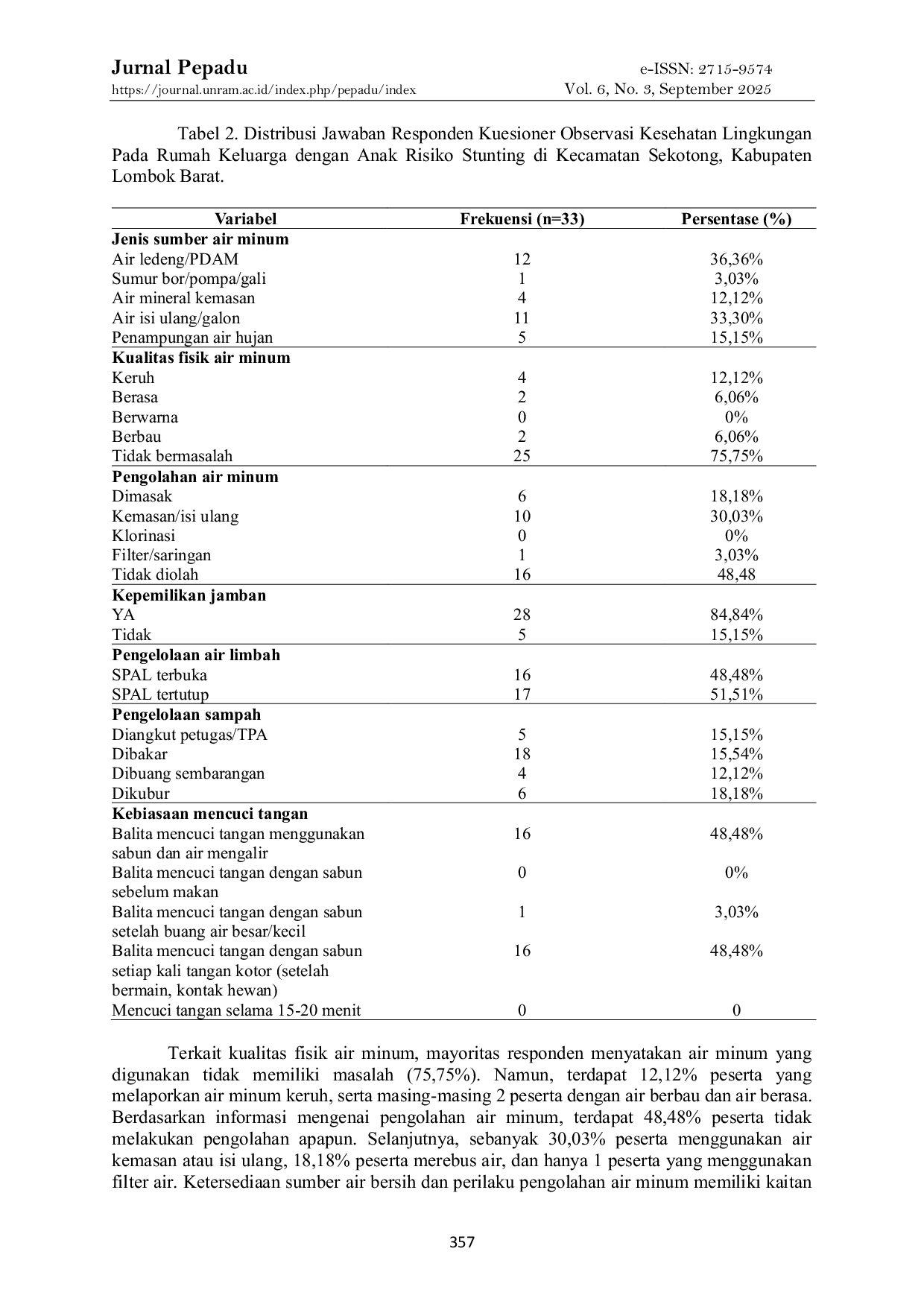
UNRAMUNRAM Sanitasi lingkungan, higiene, dan akses air bersih merupakan faktor penting dalam mencegah penyakit infeksi yang berkontribusi terhadap kejadian stuntingSanitasi lingkungan, higiene, dan akses air bersih merupakan faktor penting dalam mencegah penyakit infeksi yang berkontribusi terhadap kejadian stunting

UNRAMUNRAM Konsep ini diterapkan melalui pemanfaatan limbah perkebunan sebagai pakan kambing dan konversi kotoran kambing menjadi pupuk organik, sehingga mengurangiKonsep ini diterapkan melalui pemanfaatan limbah perkebunan sebagai pakan kambing dan konversi kotoran kambing menjadi pupuk organik, sehingga mengurangi

STAIALHIKMAHPARIANGANSTAIALHIKMAHPARIANGAN Namun, karena studi ini hanya dilakukan di satu lokasi dengan sampel terbatas, diperlukan penelitian lanjutan untuk menguji transferabilitas, keberlanjutanNamun, karena studi ini hanya dilakukan di satu lokasi dengan sampel terbatas, diperlukan penelitian lanjutan untuk menguji transferabilitas, keberlanjutan

UNRAMUNRAM Pendekatan partisipatif dan edukatif berhasil menerapkan transformasi masyarakat yang sebelumnya mengolah kolang-kaling secara konvesional menjadi kreatifPendekatan partisipatif dan edukatif berhasil menerapkan transformasi masyarakat yang sebelumnya mengolah kolang-kaling secara konvesional menjadi kreatif

STMIKBINSASTMIKBINSA Hasil uji kelayakan oleh ahli materi ditinjau dari aspek desain pembelajaran, isi materi, bahasa dan komunikasi didapat rerata persentase kelayakan yaituHasil uji kelayakan oleh ahli materi ditinjau dari aspek desain pembelajaran, isi materi, bahasa dan komunikasi didapat rerata persentase kelayakan yaitu
Useful /

LODDOSINSTITUTELODDOSINSTITUTE Praktik Kerja Industri (Prakerin) penting untuk mencapai Capaian Pembelajaran Lulusan di Sekolah Menengah Kejuruan. Oleh karena itu, siswa harus memahaminyaPraktik Kerja Industri (Prakerin) penting untuk mencapai Capaian Pembelajaran Lulusan di Sekolah Menengah Kejuruan. Oleh karena itu, siswa harus memahaminya

UPG45NTTUPG45NTT Penelitian ini menemukan (1 simile, 10 personifikasi, 4 metafora, 7 hiperbola, 1 ironi). Dalam menganalisis makna, penelitian kontekstual menemukan beberapaPenelitian ini menemukan (1 simile, 10 personifikasi, 4 metafora, 7 hiperbola, 1 ironi). Dalam menganalisis makna, penelitian kontekstual menemukan beberapa
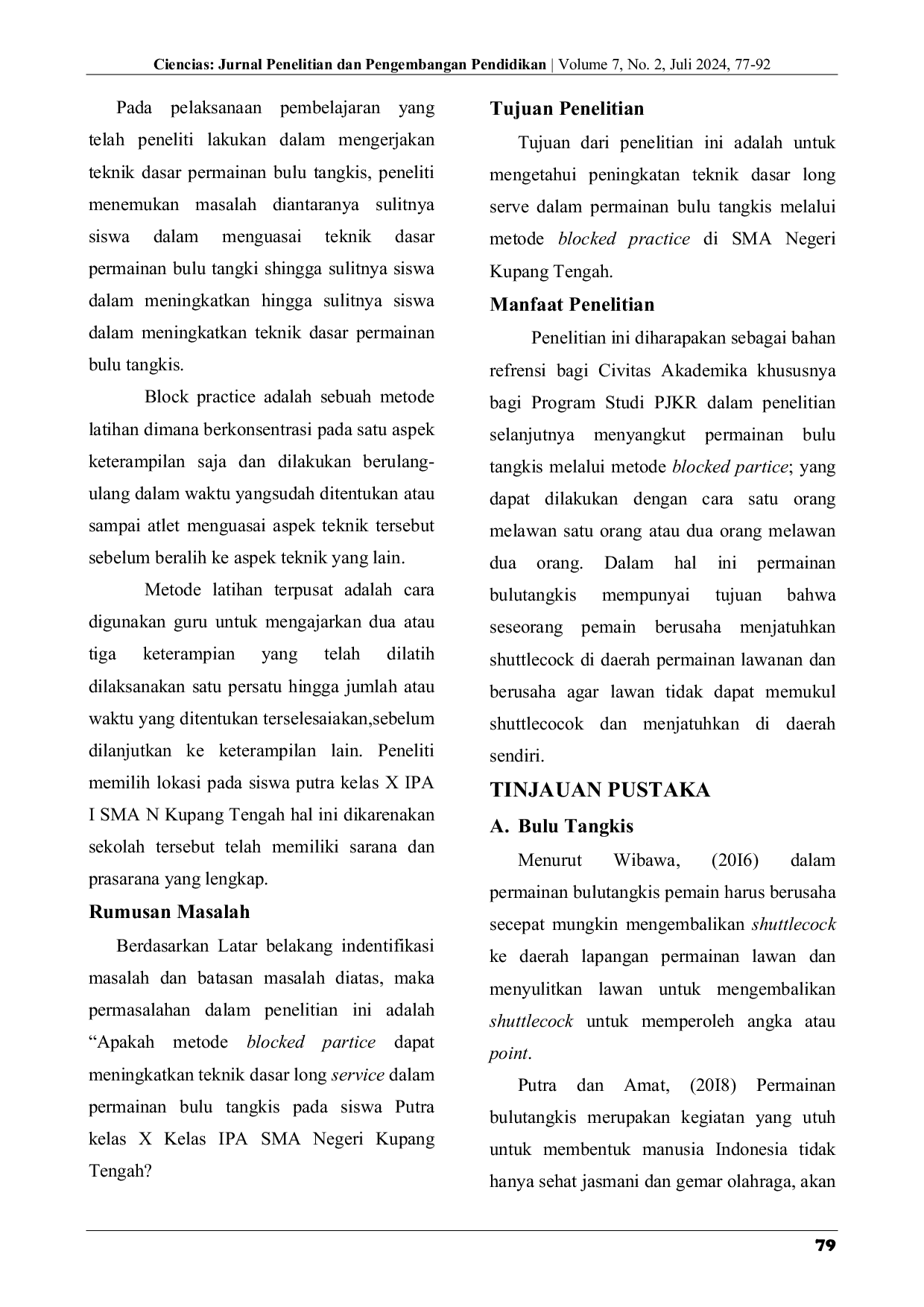
UPG45NTTUPG45NTT 857. Berdasarkan penelitian yang dilakukan dari hasil analisis data yang diperoleh, dapat disimpulkan bahwa nilai t-hitung (9. 262 pada 5%), mengindikasikan857. Berdasarkan penelitian yang dilakukan dari hasil analisis data yang diperoleh, dapat disimpulkan bahwa nilai t-hitung (9. 262 pada 5%), mengindikasikan

KETERAPIAN FISIKKETERAPIAN FISIK Penelitian ini bertujuan untuk mengevaluasi dampak pijat bayi terhadap pertambahan berat badan pada bayi di bawah 24 bulan di Kabupaten Banjar, sebuahPenelitian ini bertujuan untuk mengevaluasi dampak pijat bayi terhadap pertambahan berat badan pada bayi di bawah 24 bulan di Kabupaten Banjar, sebuah