UIN Ar-RaniryUIN Ar-Raniry
Jurnal AdabiyaJurnal AdabiyaAcademic staff members play a fundamental role in the intellectual development of institutions. This role is also reflected in the productivity level of academic staff. When academic staff are productive, it greatly contributes to the sustainability of the organization by bringing many positive impacts. Conversely, if this does not happen, there is a tendency that the organization may decline or even collapse. In this regard, this study deems it necessary to investigate motivational factors on research productivity of Academic Staff in Private Universities in Oyo State. The study used a descriptive research design of a correlational type. The population consisted of 717 academic staff in private universities in Oyo State, Nigeria. A sample size of 255 academic staff was determined using the Yamane table, while a validated questionnaire was used to collect data from the respondents. Data collected was analyzed using descriptive and inferential statistics. The results showed that motivational factors had no significant impact on research productivity (Adj. R² = 0.010; p = 0.057), while prevalent factors that bring about motivation were also found to have no statistically significant influence on Research Productivity (β = 0.165, t = 1.790; p > 0.05). The study concluded that prevalent factors that bring about motivation do not strongly influence Research Productivity. The study recommended that private universities should increase their support by facilitating access to grants for research activities of their academic staff, and academic staff should work more on their research skills.
The study found that prevalent factors that bring about motivation did not have a significant influence on the research productivity of academic staff in the selected private universities.This could be due to a lack of motivation in terms of research grant disbursement, remuneration, academic research sponsorship, and excessive workload.The study recommends that private universities in Oyo State increase their support by facilitating access to research grants, ensuring a lesser workload for academic staff, and motivating them through appreciation, such as recommendation letters, certificates, and a good salary structure.
Further research should explore the specific types of research grants and funding opportunities that would be most effective in motivating academic staff in private universities. Additionally, a qualitative study could investigate the lived experiences of academic staff regarding workload and its impact on research productivity, providing a deeper understanding of the challenges they face. Finally, research could focus on developing and evaluating mentorship programs specifically designed to enhance the research skills of academic staff in private universities, potentially leading to increased research output and a stronger research culture within these institutions. These investigations, building upon the current studys findings, could provide valuable insights for improving research productivity and fostering a more supportive environment for academic staff in private universities, ultimately contributing to the advancement of knowledge and the development of the region.
| File size | 297.94 KB |
| Pages | 11 |
| DMCA | Report |
Related /

UINSAIDUINSAID Penelitian ini bertujuan untuk mengisi kesenjangan tersebut dengan menganalisis efek langsung dan dimoderasi kualitas produk dan keputusan pengguna terhadapPenelitian ini bertujuan untuk mengisi kesenjangan tersebut dengan menganalisis efek langsung dan dimoderasi kualitas produk dan keputusan pengguna terhadap

UBHUBH Kesimpulannya, meningkatkan perilaku kerja inovatif kepala desa dapat dicapai melalui penguatan kepemimpinan diri, pengembangan kepribadian proaktif, danKesimpulannya, meningkatkan perilaku kerja inovatif kepala desa dapat dicapai melalui penguatan kepemimpinan diri, pengembangan kepribadian proaktif, dan
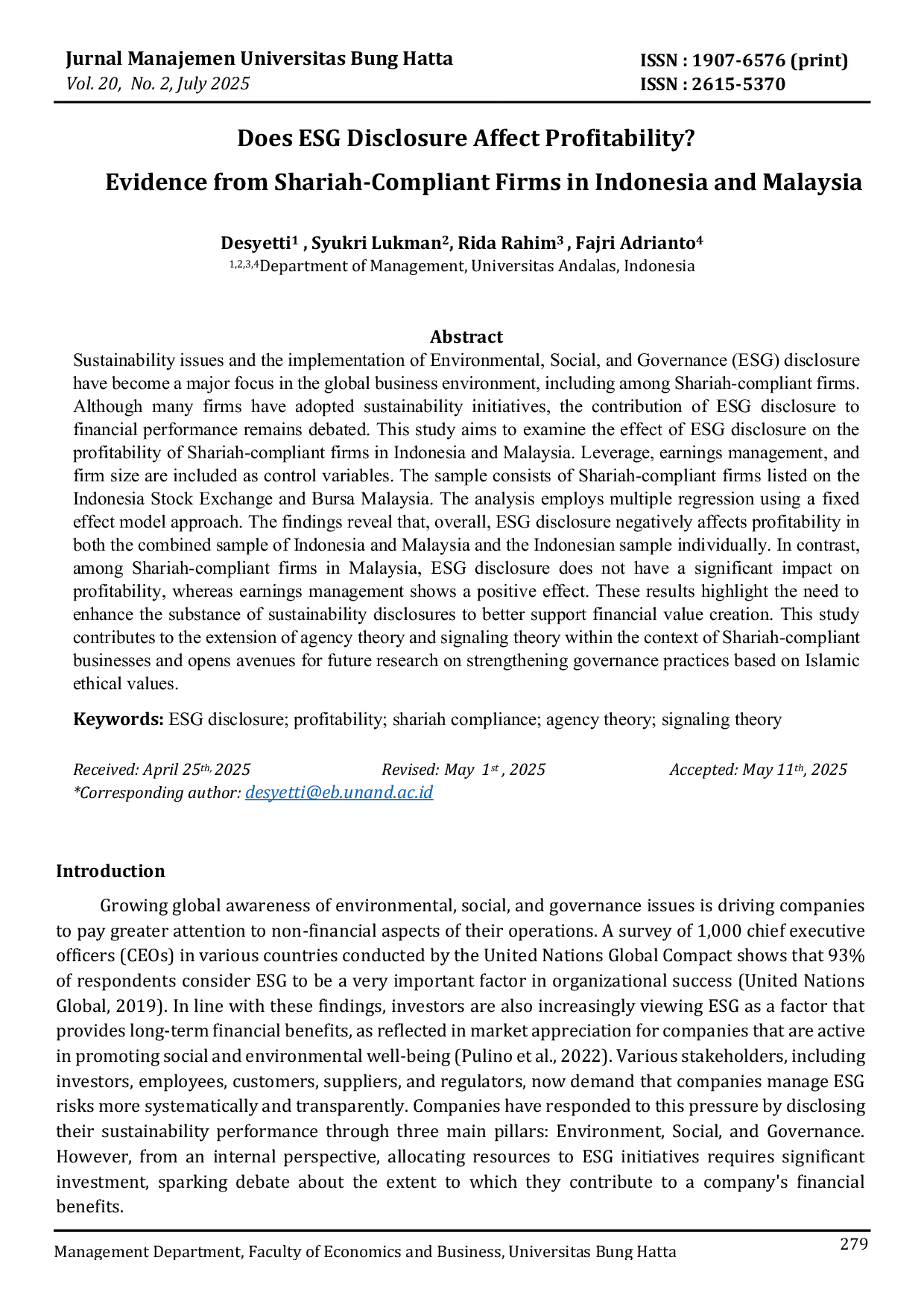
UBHUBH Hasil menunjukkan bahwa secara keseluruhan, pengungkapan ESG memiliki dampak negatif yang signifikan terhadap profitabilitas perusahaan saham syariah diHasil menunjukkan bahwa secara keseluruhan, pengungkapan ESG memiliki dampak negatif yang signifikan terhadap profitabilitas perusahaan saham syariah di

UBHUBH Variabel mediasi yang digunakan adalah kepuasan emosional, sedangkan variabel moderasi yang diuji adalah kepercayaan. Data dikumpulkan secara kuantitatifVariabel mediasi yang digunakan adalah kepuasan emosional, sedangkan variabel moderasi yang diuji adalah kepercayaan. Data dikumpulkan secara kuantitatif

STIKES AISYIYAH PALEMBANGSTIKES AISYIYAH PALEMBANG Latar Belakang: Kualitas pelayanan kesehatan merupakan faktor utama yang memengaruhi kepuasan pasien, khususnya peserta Jaminan Kesehatan Nasional (JKN).Latar Belakang: Kualitas pelayanan kesehatan merupakan faktor utama yang memengaruhi kepuasan pasien, khususnya peserta Jaminan Kesehatan Nasional (JKN).

WASTUKANCANAWASTUKANCANA Dalam penelitian ini, lima dimensi service quality yang digunakan meliputi keandalan (reliability), daya tanggap (responsiveness), jaminan (assurance),Dalam penelitian ini, lima dimensi service quality yang digunakan meliputi keandalan (reliability), daya tanggap (responsiveness), jaminan (assurance),

UTSUTS 490 > 1,960 ), ( 2. 564 > 1,960 ), ( 3. 919 > 1,960 ), yang berarti bahwa karakteristik substitusi, tingkat pendidikan, fasilitas-fasilitas, dan jarak490 > 1,960 ), ( 2. 564 > 1,960 ), ( 3. 919 > 1,960 ), yang berarti bahwa karakteristik substitusi, tingkat pendidikan, fasilitas-fasilitas, dan jarak

IAIN SUIAIN SU Nilai terendah 2,76 pada pernyataan ke-14 adalah bahwa menu repositori lengkap. Hal ini menunjukkan bahwa meskipun pengguna secara keseluruhan merasa puas,Nilai terendah 2,76 pada pernyataan ke-14 adalah bahwa menu repositori lengkap. Hal ini menunjukkan bahwa meskipun pengguna secara keseluruhan merasa puas,
Useful /

MEJAILMIAHMEJAILMIAH Hal ini dapat mengurangi efektivitas penilaian dalam meningkatkan kinerja dan kualitas pelayanan publik. Untuk mengatasi kendala tersebut, diperlukan langkah-langkahHal ini dapat mengurangi efektivitas penilaian dalam meningkatkan kinerja dan kualitas pelayanan publik. Untuk mengatasi kendala tersebut, diperlukan langkah-langkah

POLTEKTRANSSDP PALEMBANGPOLTEKTRANSSDP PALEMBANG Evaluasi menunjukkan bahwa jumlah petugas Sarana Bantu Navigasi (SBN) di menara suar Selat Riau tidak sesuai dengan Peraturan Menteri Perhubungan No. 25Evaluasi menunjukkan bahwa jumlah petugas Sarana Bantu Navigasi (SBN) di menara suar Selat Riau tidak sesuai dengan Peraturan Menteri Perhubungan No. 25

IAIQHIAIQH Pendidikan kewarganegaraan memainkan peran strategis dalam membangun sikap kritis, nasionalisme, dan toleransi di kalangan generasi muda. Dengan integrasiPendidikan kewarganegaraan memainkan peran strategis dalam membangun sikap kritis, nasionalisme, dan toleransi di kalangan generasi muda. Dengan integrasi

ISI PADANGPANJANGISI PADANGPANJANG Pembuatan video ini menggunakan metode MDLC (Multimedia Development Life Cycle). Karya yang dihasilkan berjumlah 12 video promosi. Penelitian ini menunjukkanPembuatan video ini menggunakan metode MDLC (Multimedia Development Life Cycle). Karya yang dihasilkan berjumlah 12 video promosi. Penelitian ini menunjukkan