UHBUHB
Jurnal Hukum In ConcretoJurnal Hukum In ConcretoDepopulation and demographic aging present critical threats to rural economies in Japan, particularly in municipalities like Yoshinogawa where small businesses struggle to sustain operations within a shrinking consumer base. This study investigates the resilience of local businesses using a mixed-methods approach that integrates quantitative data from household surveys (n=100) with qualitative insights gathered from interviews, field observations, and case studies. Descriptive statistics were applied to examine consumer behavior, while thematic coding was employed to analyze adaptive business strategies and patterns of community engagement. The results reveal that local business survival depends not on technological innovation or economic expansion but on strong social embeddedness, especially among elderly consumers who act as both vulnerable clients and stabilizing actors through consistent patronage and emotional loyalty. Shopkeepers have responded with micro-level adaptations such as reducing operating hours, offering elderly-friendly services, and transforming their premises into multifunctional community hubs. Despite these efforts, structural challenges including the lack of generational succession, digital exclusion, and limited access to policy support continue to threaten long-term viability. The findings suggest that place-based policy interventions that leverage social capital, promote intergenerational collaboration, and support embedded innovation are essential to sustain economic activity in depopulated areas. The case of Yoshinogawa provides a counter-narrative to prevailing assumptions about rural decline by demonstrating how resilience can emerge from community cohesion and relational infrastructure.
The study reveals that the sustainability of local businesses in Yoshinogawa is deeply intertwined with community resilience and the role of elderly consumers.Businesses have adapted through micro-level strategies focused on social connection and personalized service, rather than relying on conventional economic growth models.However, long-term viability is threatened by structural challenges such as generational succession and limited policy support, necessitating targeted interventions that leverage social capital and promote intergenerational collaboration.
Further research should investigate the potential of intergenerational business models, where younger individuals are incentivized to take over existing businesses and integrate modern technologies while preserving local traditions. Additionally, studies could explore the effectiveness of digital literacy programs specifically designed for elderly residents to enhance their access to online services and markets. Finally, research is needed to assess the impact of place-based policy interventions, such as micro-financing schemes and community-led revitalization initiatives, on the long-term sustainability of rural economies in depopulated areas. These investigations should prioritize qualitative methodologies to capture the nuanced experiences of local actors and inform the development of context-sensitive solutions. Understanding how to foster a sense of belonging and purpose among residents, particularly the elderly, is crucial for building resilient communities capable of navigating demographic change and sustaining economic activity. This requires a shift in focus from purely economic indicators to encompass social, cultural, and emotional dimensions of well-being, recognizing that the value of local businesses extends beyond their financial contributions to encompass their role as social hubs and keepers of community identity.
- More-than-Human Commoning through Women’s Kokorozashi Business for Collective Well-being:... doi.org/10.5334/ijc.1215More than Human Commoning through WomenAos KokorozashiABusiness for Collective Well being doi 10 5334 ijc 1215
- Community-Level Social Capital and Psychological Distress among the Elderly in Japan: A Population-Based... doi.org/10.1371/journal.pone.0142629Community Level Social Capital and Psychological Distress among the Elderly in Japan A Population Based doi 10 1371 journal pone 0142629
- Rural Depopulation: Growth and Decline Processes over the Past Century - Johnson - 2019 - Rural Sociology... onlinelibrary.wiley.com/doi/10.1111/ruso.12266Rural Depopulation Growth and Decline Processes over the Past Century Johnson 2019 Rural Sociology onlinelibrary wiley doi 10 1111 ruso 12266
| File size | 489.34 KB |
| Pages | 15 |
| DMCA | Report |
Related /
POLITEKNIK KEBUMENPOLITEKNIK KEBUMEN Penelitian ini bertujuan untuk menganalisis pengaruh tingkat pendidikan, kesehatan dan pengangguran terbuka terhadap kemiskinan di Indonesia. PenelitianPenelitian ini bertujuan untuk menganalisis pengaruh tingkat pendidikan, kesehatan dan pengangguran terbuka terhadap kemiskinan di Indonesia. Penelitian
POLITEKNIK KEBUMENPOLITEKNIK KEBUMEN Hasil penelitian menunjukkan harga jual, volume penjualan, biaya bahan baku, biaya tenaga kerja, lama usaha, dan pemasaran online secara simultan berpengaruhHasil penelitian menunjukkan harga jual, volume penjualan, biaya bahan baku, biaya tenaga kerja, lama usaha, dan pemasaran online secara simultan berpengaruh
POLITEKNIK KEBUMENPOLITEKNIK KEBUMEN Selain itu, dukungan sosial dari lingkungan sekitar, seperti keluarga, teman, dan dosen, berfungsi sebagai pendorong motivasi dan kepercayaan diri mahasiswaSelain itu, dukungan sosial dari lingkungan sekitar, seperti keluarga, teman, dan dosen, berfungsi sebagai pendorong motivasi dan kepercayaan diri mahasiswa

POLITEKNIK KEBUMENPOLITEKNIK KEBUMEN Independensi berpengaruh negatif, yang menunjukkan bahwa auditor yang mampu menjaga independensinya cenderung lebih patuh terhadap prosedur dan etika profesi.Independensi berpengaruh negatif, yang menunjukkan bahwa auditor yang mampu menjaga independensinya cenderung lebih patuh terhadap prosedur dan etika profesi.
POLITEKNIK KEBUMENPOLITEKNIK KEBUMEN Kemudian, kepuasan kerja ditemukan berpengaruh positif dan signifikan pada OCB, dan juga memediasi hubungan antara keadilan organisasi dan OCB. KeadilanKemudian, kepuasan kerja ditemukan berpengaruh positif dan signifikan pada OCB, dan juga memediasi hubungan antara keadilan organisasi dan OCB. Keadilan

POLITEKNIK KEBUMENPOLITEKNIK KEBUMEN Ketiga faktor tersebut saling melengkapi dalam meningkatkan kesiapan mahasiswa menghadapi dunia kerja. Oleh karena itu, pihak universitas sebaiknya merancangKetiga faktor tersebut saling melengkapi dalam meningkatkan kesiapan mahasiswa menghadapi dunia kerja. Oleh karena itu, pihak universitas sebaiknya merancang

POLITEKNIK KEBUMENPOLITEKNIK KEBUMEN Hasil tersebut menunjukkan bahwa perilaku petani dalam mengambil keputusan keuangannya dilakukan cenderung berfikir ke arah jangka panjang dan sebagianHasil tersebut menunjukkan bahwa perilaku petani dalam mengambil keputusan keuangannya dilakukan cenderung berfikir ke arah jangka panjang dan sebagian

POLITEKNIK KEBUMENPOLITEKNIK KEBUMEN Tujuan dari studi ini adalah untuk menyelidiki bagaimana perilaku kerja inventif karyawan dipengaruhi oleh keyakinan pribadi, inisiatif, dan kepemimpinanTujuan dari studi ini adalah untuk menyelidiki bagaimana perilaku kerja inventif karyawan dipengaruhi oleh keyakinan pribadi, inisiatif, dan kepemimpinan
Useful /
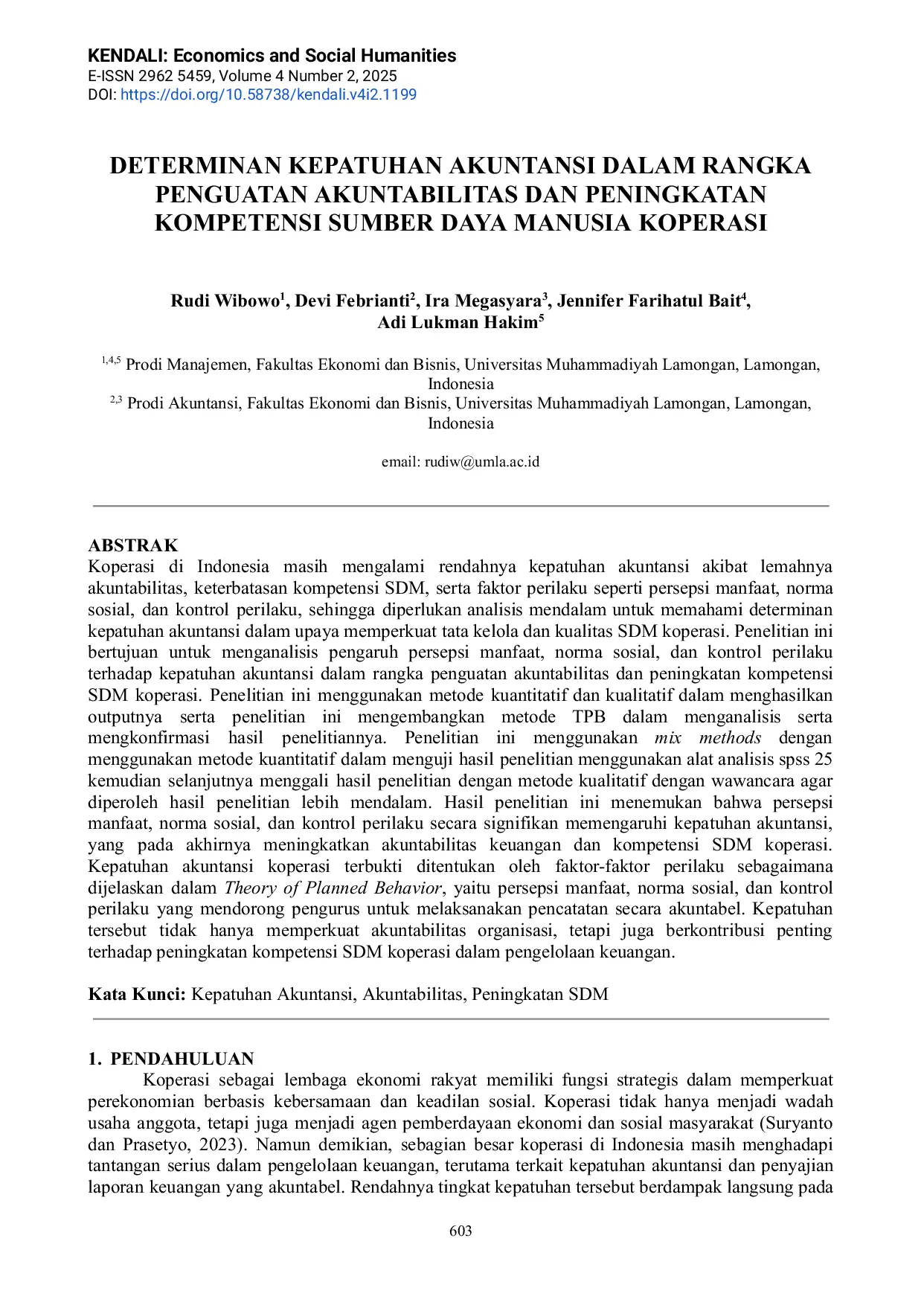
ASIANPUBLISHERASIANPUBLISHER Hasil menunjukkan bahwa persepsi manfaat, norma sosial, dan kontrol perilaku secara signifikan meningkatkan kepatuhan akuntansi, yang pada gilirannya memperkuatHasil menunjukkan bahwa persepsi manfaat, norma sosial, dan kontrol perilaku secara signifikan meningkatkan kepatuhan akuntansi, yang pada gilirannya memperkuat

POLITEKNIK KEBUMENPOLITEKNIK KEBUMEN Sementara itu, Efikasi Diri terbukti mendorong keberanian mengambil risiko, kemampuan berinovasi, serta adaptasi terhadap perubahan. Secara simultan, keduaSementara itu, Efikasi Diri terbukti mendorong keberanian mengambil risiko, kemampuan berinovasi, serta adaptasi terhadap perubahan. Secara simultan, kedua

UNIPASBYUNIPASBY Remaja mengalami masalah gizi karena tumbuh kembang yang sangat pesat dan membutuhkan energi cukup untuk beragam aktivitas fisik, sehingga penting meningkatkanRemaja mengalami masalah gizi karena tumbuh kembang yang sangat pesat dan membutuhkan energi cukup untuk beragam aktivitas fisik, sehingga penting meningkatkan

KEMNAKERKEMNAKER Mengingat kemampuan negara dalam membiayai program perlindungan sosial yang sifatnya non‑kontribusi sangat terbatas, maka untuk menciptakan perlindunganMengingat kemampuan negara dalam membiayai program perlindungan sosial yang sifatnya non‑kontribusi sangat terbatas, maka untuk menciptakan perlindungan