PDSIPDSI
Bulletin of Informatics and Data ScienceBulletin of Informatics and Data ScienceDiabetes is a major cause of many chronic diseases such as visual impairment, stroke and kidney failure. Early detection especially in groups that have a high risk of developing diabetes needs to be done to prevent problems that have a wide impact. Indonesia is ranked seventh in the world with a prevalence of 10.7% of the total number of people with diabetes. This research aims to determine the attributes in the diabetes dataset that most affect the classification and apply the Support Vector Machine method for diabetes classification. For the determination process, Gain Ratio feature selection technique is applied. The dataset used consists of 768 data with 8 attributes. In this classification process, 3 SVM kernels (Linear, Polynomial, and RBF) are used with three possible data divisions using the ratio (70:30; 80:20; 90:10). Before applying feature selection, there were 8 attributes used and achieved the highest accuracy of 94.81% at a ratio of 80:20 using the RBF kernel with a combination of two parameters namely C = 100, Gamma = 3 and C = 100, Gamma = Scale. Feature selection parameters in the form of thresholds used include 0.02; 0.03; and 0.05. After applying feature selection, the attribute that produces the highest accuracy uses 6 attributes. The highest accuracy after applying feature selection reached 95.45% at a threshold of 0.02 with a ratio of 80:20 using the RBF kernel with parameters C = 100 and Gamma = Scale. The results showed that there was an increase in accuracy after applying feature selection.
The application of the Gain Ratio feature selection in the Support Vector Machine method successfully increased the accuracy of diabetes classification by 0.20 data ratio, and the RBF kernel with parameters C = 100 and Gamma = Scale.The RBF kernel consistently demonstrated optimal performance.The right combination of threshold, data ratio, and kernel parameters can produce a more reliable model for predicting diabetes risk.
Penelitian lebih lanjut dapat dilakukan dengan mengeksplorasi teknik data balancing untuk mengatasi ketidakseimbangan jumlah data antara kelas diabetes dan non-diabetes, karena hal ini berpotensi meningkatkan kinerja model klasifikasi. Selain itu, penelitian dapat diperluas dengan menguji kombinasi parameter yang lebih beragam pada algoritma SVM, termasuk penggunaan teknik optimasi parameter otomatis untuk menemukan konfigurasi terbaik. Sebagai pengembangan, studi komparatif dapat dilakukan dengan menerapkan teknik seleksi fitur Gain Ratio pada algoritma machine learning lainnya, seperti Random Forest atau Decision Tree, untuk mengidentifikasi algoritma mana yang paling efektif dalam memprediksi risiko diabetes. Penelitian ini juga dapat diperkaya dengan mempertimbangkan faktor-faktor lain yang mungkin mempengaruhi risiko diabetes, seperti data gaya hidup, riwayat keluarga, atau informasi genetik, untuk membangun model prediksi yang lebih komprehensif dan akurat. Terakhir, validasi model pada dataset yang lebih besar dan beragam dari berbagai populasi dapat dilakukan untuk memastikan generalisasi dan keandalan model dalam aplikasi dunia nyata.
- Komparasi Information Gain, Gain Ratio, CFs-Bestfirst dan CFs-PSO Search Terhadap Performa Deteksi Anomali... ejurnal.stmik-budidarma.ac.id/index.php/mib/article/view/2258Komparasi Information Gain Gain Ratio CFs Bestfirst dan CFs PSO Search Terhadap Performa Deteksi Anomali ejurnal stmik budidarma ac index php mib article view 2258
- Performance Analysis of LVQ 1 Using Feature Selection Gain Ratio for Sex Classification in Forensic Anthropology... ejurnal.seminar-id.com/index.php/bits/article/view/3625Performance Analysis of LVQ 1 Using Feature Selection Gain Ratio for Sex Classification in Forensic Anthropology ejurnal seminar id index php bits article view 3625
| File size | 706.23 KB |
| Pages | 12 |
| DMCA | Report |
Related /
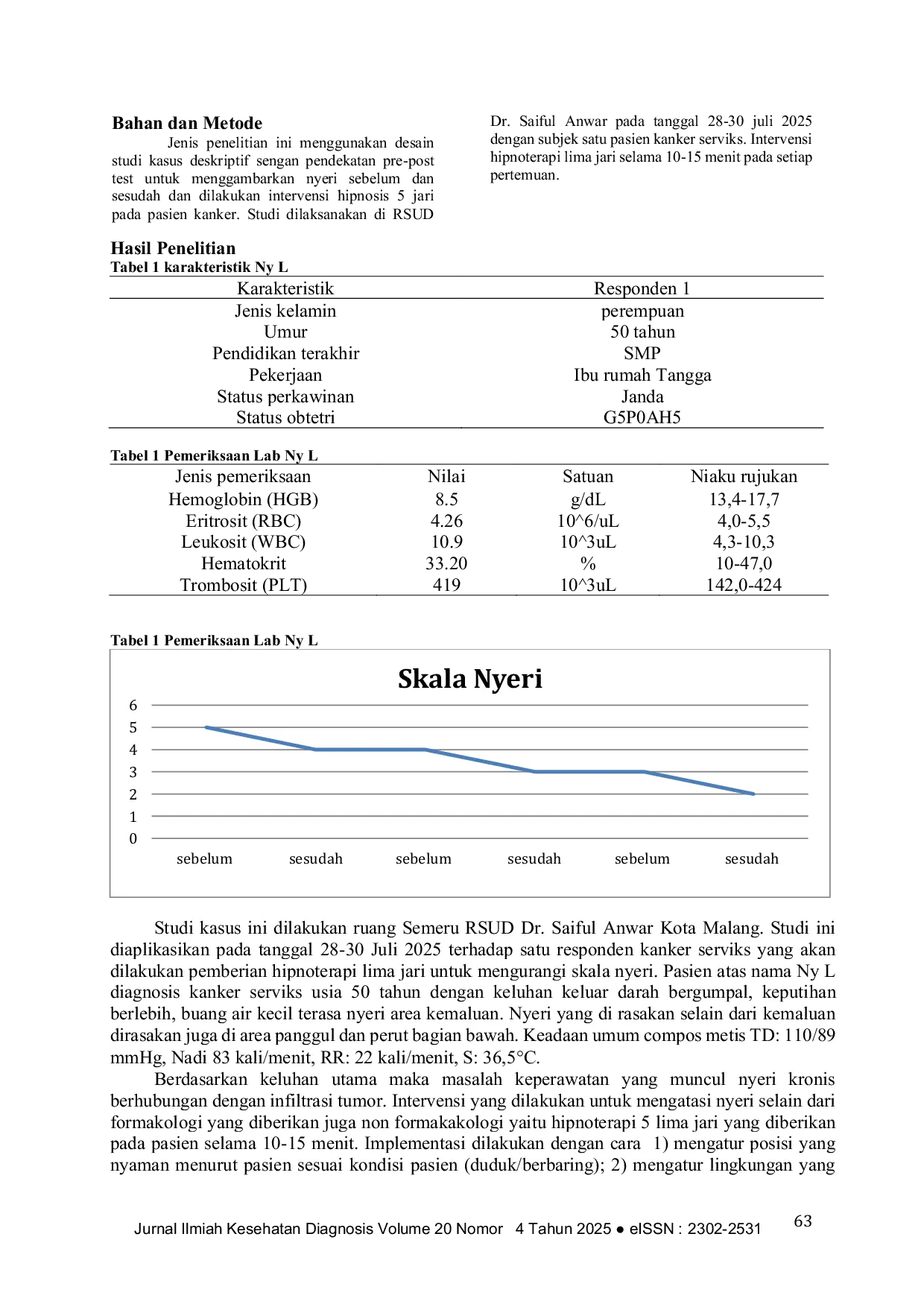
STIKESNHSTIKESNH Pembahasan: Hipnoterapi lima jari merupakan teknik yang memanfaatkan imajinasi melalui jari tangan dengan membayangkan hal-hal yang menyenangkan. mekanismePembahasan: Hipnoterapi lima jari merupakan teknik yang memanfaatkan imajinasi melalui jari tangan dengan membayangkan hal-hal yang menyenangkan. mekanisme
POLTEKKES SORONGPOLTEKKES SORONG Hasil lain menunjukkan nilai chi-square hitung (126,6427) > chi-square tabel (9,488), yang mengindikasikan hubungan signifikan antara Social Support danHasil lain menunjukkan nilai chi-square hitung (126,6427) > chi-square tabel (9,488), yang mengindikasikan hubungan signifikan antara Social Support dan
POLTEKKES SORONGPOLTEKKES SORONG Kesimpulannya, metode self-healing dengan teknik Butterfly Hug berpengaruh signifikan dalam menurunkan kecemasan mahasiswa keperawatan selama penyusunanKesimpulannya, metode self-healing dengan teknik Butterfly Hug berpengaruh signifikan dalam menurunkan kecemasan mahasiswa keperawatan selama penyusunan

POLTEKKES SORONGPOLTEKKES SORONG Instrumen berupa kuesioner dan dianalisis dengan uji frekuensi. Hasil menunjukkan remaja tahap tengah mendominasi (94,2%) dengan 94,8% memiliki pengetahuanInstrumen berupa kuesioner dan dianalisis dengan uji frekuensi. Hasil menunjukkan remaja tahap tengah mendominasi (94,2%) dengan 94,8% memiliki pengetahuan
PELNIPELNI Penelitian ini menggunakan jenis pre-test dan post-test, membentuk 1 kelompok. Teknik pengambilan sampel dalam penelitian ini menggunakan non probabilityPenelitian ini menggunakan jenis pre-test dan post-test, membentuk 1 kelompok. Teknik pengambilan sampel dalam penelitian ini menggunakan non probability

JURNALFKMUITJURNALFKMUIT Penelitian ini menggunakan desain analitik observasional dengan rancangan cross-sectional study. Sampel sebanyak 42 diambil melalui accidental sampling.Penelitian ini menggunakan desain analitik observasional dengan rancangan cross-sectional study. Sampel sebanyak 42 diambil melalui accidental sampling.

UKIMUKIM Kesimpulan penelitian ini adalah adanya hubungan yang signifikan antara obesitas sentral dan riwayat keluarga dengan peningkatan kadar asam urat di WilayahKesimpulan penelitian ini adalah adanya hubungan yang signifikan antara obesitas sentral dan riwayat keluarga dengan peningkatan kadar asam urat di Wilayah
UNTAGUNTAG Kepercayaan diri dan body image memberikan sumbangan efektif sebesar 35,2% terhadap kecenderungan anorexia nervosa, sementara 64,8% dipengaruhi oleh faktorKepercayaan diri dan body image memberikan sumbangan efektif sebesar 35,2% terhadap kecenderungan anorexia nervosa, sementara 64,8% dipengaruhi oleh faktor
Useful /
PELNIPELNI Instrumen yang digunakan adalah Infusion Nurse Society (INS), SOP kompres Aloe Vera, meteran dan lembar observasi derajat flebitis. Kompres Aloe Vera diberikanInstrumen yang digunakan adalah Infusion Nurse Society (INS), SOP kompres Aloe Vera, meteran dan lembar observasi derajat flebitis. Kompres Aloe Vera diberikan
PPJBSIPPPJBSIP Temuan tulisan ini adalah alih wahana yang ditunjukkan mencakup nama-nama tokoh-tokoh dalam dongeng klasik tersebut berganti sehingga karakter mereka punTemuan tulisan ini adalah alih wahana yang ditunjukkan mencakup nama-nama tokoh-tokoh dalam dongeng klasik tersebut berganti sehingga karakter mereka pun
SINESIASINESIA Penelitian ini bertujuan memahami permasalahan terkait Kesenian Genggong Sumedang yang belum mendapatkan pelindungan defensif sebagai objek Kekayaan IntelektualPenelitian ini bertujuan memahami permasalahan terkait Kesenian Genggong Sumedang yang belum mendapatkan pelindungan defensif sebagai objek Kekayaan Intelektual

UNIBUNIB Sedangkan untuk penggunaan (petunjuk penggunaan dan antarmuka pengguna), hasilnya secara umum adalah setuju. Berdasarkan hasil distribusi kuesioner kepadaSedangkan untuk penggunaan (petunjuk penggunaan dan antarmuka pengguna), hasilnya secara umum adalah setuju. Berdasarkan hasil distribusi kuesioner kepada