IAESONLINEIAESONLINE
Indonesian Journal of Electrical Engineering and Informatics (IJEEI)Indonesian Journal of Electrical Engineering and Informatics (IJEEI)Intrusion Detection Systems (IDS) are essential for maintaining the security of cloud computing environments, which are increasingly targeted by sophisticated cyber-attacks. This paper presents a novel hybrid approach for intrusion detection in cloud environments, combining Random Forest for feature selection, Long Short-Term Memory (LSTM) networks for temporal pattern recognition, and Transformer networks for contextual learning. Evaluated on CICIDS2017 and CSE-CIC-IDS2018 datasets, the proposed approach achieved weighted F1-scores of 97% and 99% respectively, significantly outperforming baseline models. The hybrid model improved accuracy from 95.1% to 98.0% and F1-score from 94.2% to 97.0% compared to LSTM-only approaches. While excelling at detecting common attack patterns such as Distributed Denial of Services (DDoS), challenges remain in identifying rare threats including SQL Injection. This research contributes to cloud security advancement by demonstrating the effectiveness of hybrid machine learning architectures in addressing the unique challenges of intrusion detection in distributed cloud infrastructures.
The hybrid model demonstrated strong overall performance in detecting common attack types such as DoS, DDoS, and brute force attempts.However, challenges remain in identifying rare and sophisticated attack types, particularly SQL Injection, Web Attacks, and Infiltration.This highlights a fundamental challenge in intrusion detection research.The model maintains sufficient efficiency for real-time monitoring in practical deployment scenarios, processing approximately 5,000 flows per second on standard hardware.
Berdasarkan penelitian ini, beberapa saran penelitian lanjutan dapat diajukan. Pertama, perlu dilakukan pengembangan model yang lebih baik dalam mendeteksi serangan yang jarang terjadi (rare attacks) seperti SQL Injection dan Web Attacks. Hal ini dapat dicapai dengan menggunakan teknik data augmentation atau transfer learning untuk meningkatkan representasi data serangan tersebut. Kedua, penelitian dapat difokuskan pada peningkatan interpretasi model deep learning, sehingga dapat dipahami alasan di balik keputusan klasifikasi yang diambil. Teknik Explainable AI (XAI) dapat diterapkan untuk memberikan wawasan yang lebih jelas tentang bagaimana model bekerja. Ketiga, penelitian dapat mengeksplorasi integrasi dengan threat intelligence feeds untuk meningkatkan kemampuan model dalam mendeteksi serangan baru dan yang belum pernah terjadi sebelumnya. Dengan menggabungkan informasi dari berbagai sumber, model dapat lebih adaptif dan responsif terhadap ancaman yang terus berkembang.
- Enhancing Intrusion Detection Systems in Cloud Computing Environments: A Hybrid Machine Learning Approach... doi.org/10.52549/ijeei.v13i3.6713Enhancing Intrusion Detection Systems in Cloud Computing Environments A Hybrid Machine Learning Approach doi 10 52549 ijeei v13i3 6713
- RID-Cloud: Spectral Recurrent Neural Network-Based Intrusion Detection in Cloud Environment: IETE Journal... doi.org/10.1080/03772063.2024.2428740RID Cloud Spectral Recurrent Neural Network Based Intrusion Detection in Cloud Environment IETE Journal doi 10 1080 03772063 2024 2428740
- An Advanced Neural Network Framework for Intrusion Detection | Research Square. advanced neural network... doi.org/10.21203/rs.3.rs-4043594/v1An Advanced Neural Network Framework for Intrusion Detection Research Square advanced neural network doi 10 21203 rs 3 rs 4043594 v1
| File size | 699.68 KB |
| Pages | 11 |
| DMCA | Report |
Related /
UMBUMB Model seperti k-Nearest Neighbor (k-NN), Support Vector Machine (SVM), Logistic Regression, Neural Network, dan Ensemble menunjukkan tingkat akurasi rata-rataModel seperti k-Nearest Neighbor (k-NN), Support Vector Machine (SVM), Logistic Regression, Neural Network, dan Ensemble menunjukkan tingkat akurasi rata-rata
UNPRIUNPRI Diharapkan, sistem ini bisa membantu tenaga medis dalam mendiagnosis aritmia dengan lebih cepat dan akurat, serta mendukung perkembangan teknologi kesehatanDiharapkan, sistem ini bisa membantu tenaga medis dalam mendiagnosis aritmia dengan lebih cepat dan akurat, serta mendukung perkembangan teknologi kesehatan

STMIKJAYAKARTASTMIKJAYAKARTA Aplikasi yang dirancang berfungsi untuk menganalisis sentimen teks secara real-time dengan tingkat akurasi tinggi. Metode pengembangan sistem yang digunakanAplikasi yang dirancang berfungsi untuk menganalisis sentimen teks secara real-time dengan tingkat akurasi tinggi. Metode pengembangan sistem yang digunakan

STMIKJAYAKARTASTMIKJAYAKARTA Pendekatan tunggal seperti Collaborative Filtering atau Content-Based Filtering seringkali menghadapi kendala seperti masalah cold start dan data sparsity.Pendekatan tunggal seperti Collaborative Filtering atau Content-Based Filtering seringkali menghadapi kendala seperti masalah cold start dan data sparsity.

UBHINUSUBHINUS Namun, pemeriksaan mikroskopis memerlukan keahlian khusus dan waktu yang cukup lama. Penelitian ini bertujuan mengembangkan model sistem deteksi parasitNamun, pemeriksaan mikroskopis memerlukan keahlian khusus dan waktu yang cukup lama. Penelitian ini bertujuan mengembangkan model sistem deteksi parasit

STMIKJAYAKARTASTMIKJAYAKARTA Adapun metode penelitian yang digunakan adalah penelitian Metode Rapid Application Development Menggunakan Algoritma String Matching, dalam prosesnya terdiriAdapun metode penelitian yang digunakan adalah penelitian Metode Rapid Application Development Menggunakan Algoritma String Matching, dalam prosesnya terdiri

STMIKJAYAKARTASTMIKJAYAKARTA Penelitian ini juga mengusulkan penggunaan state yang lebih sedikit, penggunaan uang kertas sebagai input untuk meningkatkan efisiensi dan biaya desainPenelitian ini juga mengusulkan penggunaan state yang lebih sedikit, penggunaan uang kertas sebagai input untuk meningkatkan efisiensi dan biaya desain

STMIKJAYAKARTASTMIKJAYAKARTA Perpustakaan Keliling pada Suku Dinas Perpustakaan dan Kearsipan Kota Administrasi Jakarta Utara merupakan perpustakaan keliling yang bergerak di bidangPerpustakaan Keliling pada Suku Dinas Perpustakaan dan Kearsipan Kota Administrasi Jakarta Utara merupakan perpustakaan keliling yang bergerak di bidang
Useful /
UMBUMB Tahapan penelitian diawali dengan prapemrosesan teks, Setelah itu, data diproses melalui ekstraksi fitur menggunakan metode Term Frequency–Inverse DocumentTahapan penelitian diawali dengan prapemrosesan teks, Setelah itu, data diproses melalui ekstraksi fitur menggunakan metode Term Frequency–Inverse Document

STMIKJAYAKARTASTMIKJAYAKARTA Dalam kancah dunia bisnis, terutama untuk bisnis jasa, terdapat banyak strategi untuk membuat sebuah bisnis sukses. Selain strategi pemasaran yang handal,Dalam kancah dunia bisnis, terutama untuk bisnis jasa, terdapat banyak strategi untuk membuat sebuah bisnis sukses. Selain strategi pemasaran yang handal,
STMIKJAYAKARTASTMIKJAYAKARTA Dalam melaksanakan tugas, Kementerian Pekerjaan Umum dan Perumahan Rakyat menyelenggarakan fungsi, salah satunya adalah pengelolaan barang milik/kekayaanDalam melaksanakan tugas, Kementerian Pekerjaan Umum dan Perumahan Rakyat menyelenggarakan fungsi, salah satunya adalah pengelolaan barang milik/kekayaan
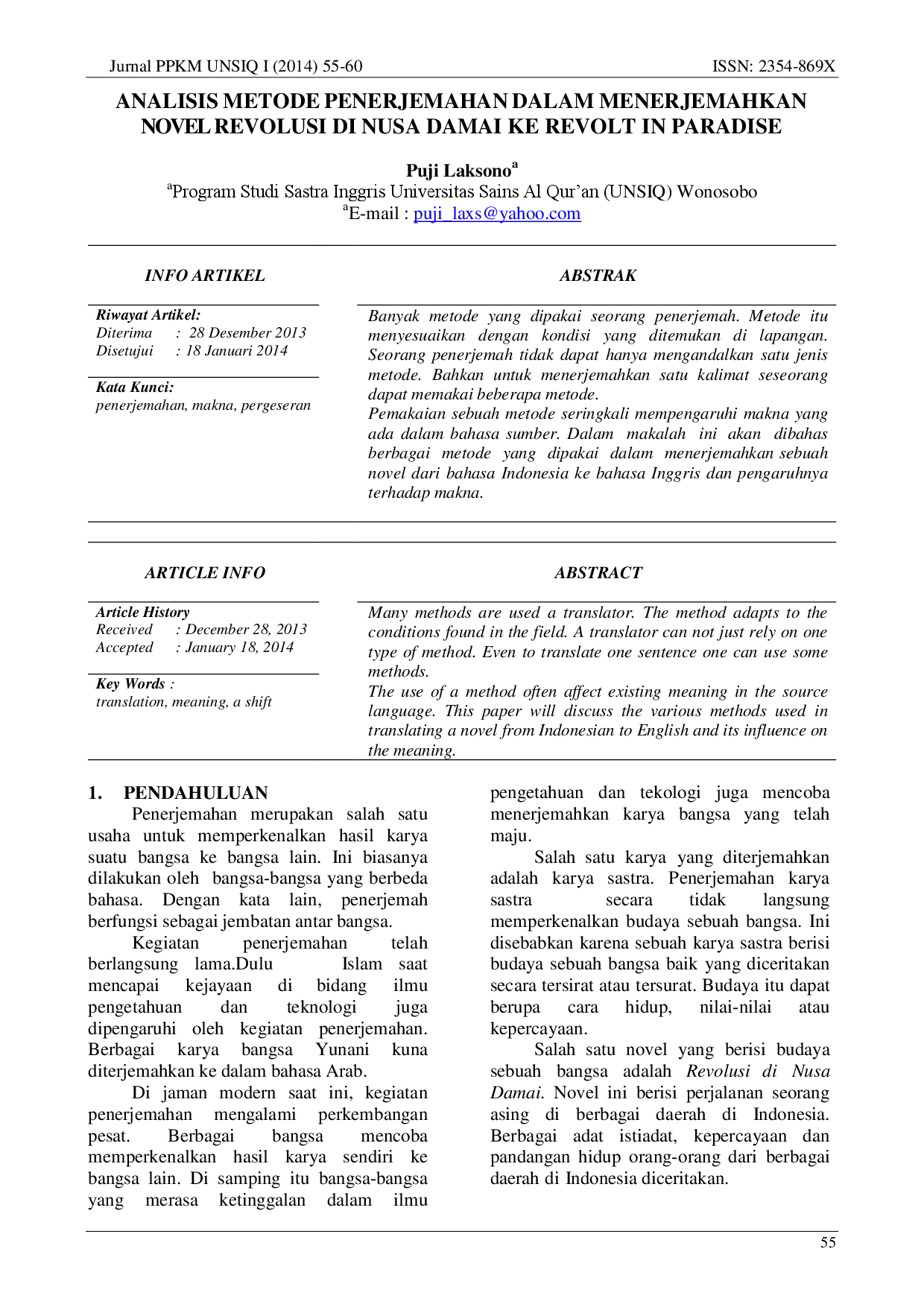
UNSIQUNSIQ Pemakaian sebuah metode seringkali mempengaruhi makna yang ada dalam bahasa sumber. Dalam makalah ini akan dibahas berbagai metode yang dipakai dalam menerjemahkanPemakaian sebuah metode seringkali mempengaruhi makna yang ada dalam bahasa sumber. Dalam makalah ini akan dibahas berbagai metode yang dipakai dalam menerjemahkan