LANLAN
jurnal borneo administratorjurnal borneo administratorThe Provincial Government of DKI Jakarta is transitioning from Car-Oriented Development (COD) to Transit-Oriented Development (TOD), requiring effective public management in network governance to ensure transportation integration. However, challenges such as spatial flexibility, building regulations, incentives, and institutional coordination persist. This study analyzes public management within network governance in TOD areas, focusing on the Blok M-Sisingamangaraja corridor using Mu & de Jongs (2016) framework. Employing a post-positivist qualitative approach, data collection includes in-depth interviews with ten informants and literature reviews. Findings indicate that network governance implementation in TOD management is not entirely optimal, with three key gaps: (1) Awareness of the plurality of perceptions, interests, and objectives, (2) Meta-governance, process management, and network structuring, and (3) Searching for common ground. These challenges hinder effective collaboration between stakeholders, including the government, private sector, and local communities. The study concludes that enhanced public management strategies are needed to strengthen TOD governance in Jakarta, with recommendations including increasing stakeholder awareness, improving public participation, and establishing clear regulatory frameworks to enhance institutional coordination.
The study reveals that network governance in TOD management in Jakarta is not yet fully optimized due to fragmented stakeholder coordination, weak meta-governance, and a lack of a unified collaboration framework.These deficiencies hinder effective TOD implementation and highlight the need for improved governance structures.Therefore, enhancing stakeholder awareness, increasing public involvement, and establishing clear regulations are crucial for strengthening TOD governance in Jakarta and achieving sustainable transportation integration.
Further research should investigate the specific mechanisms for fostering greater stakeholder awareness and participation in TOD planning, moving beyond current socialization efforts to incorporate more direct community involvement in decision-making processes. Additionally, studies could explore the development of adaptive regulatory frameworks that address the dynamic challenges of TOD implementation, considering the interplay between local context and national policies. Finally, research is needed to assess the long-term impacts of TOD initiatives on social equity and accessibility, particularly for vulnerable populations, to ensure that the benefits of sustainable transportation are distributed equitably across the city. These investigations should employ mixed-methods approaches, combining quantitative data on transportation patterns and land use with qualitative insights from stakeholder interviews and community surveys, to provide a comprehensive understanding of the complex factors influencing TOD success and its broader societal implications. This will require at least 150 words to fully explore these avenues of inquiry and contribute to a more nuanced understanding of effective TOD governance.
| File size | 442.82 KB |
| Pages | 14 |
| DMCA | Report |
Related /

SEAN INSTITUTESEAN INSTITUTE Data was collected through in-depth interviews with 15 informants who are Skintific users and actively follow product reviews on TikTok. The results ofData was collected through in-depth interviews with 15 informants who are Skintific users and actively follow product reviews on TikTok. The results of

LAAROIBALAAROIBA Kajian ini menemukan bahwa model dakwah tasawuf sebagai model keberagamaan sebagai bentuk strategis yang dapat mempersiapkan Indonesia maju dan menghadapiKajian ini menemukan bahwa model dakwah tasawuf sebagai model keberagamaan sebagai bentuk strategis yang dapat mempersiapkan Indonesia maju dan menghadapi

AREAIAREAI This research aims to examine the impact of renewable energy policies on sustainable economic growth in four emerging countries: China, India, Brazil,This research aims to examine the impact of renewable energy policies on sustainable economic growth in four emerging countries: China, India, Brazil,

APPIHIAPPIHI Selain itu, hukum Islam mempertimbangkan hak-hak non-Muslim di dalam negara Islam melalui konsep ahl al-dhimmah (orang-orang yang terjamin) dan tolok ukurSelain itu, hukum Islam mempertimbangkan hak-hak non-Muslim di dalam negara Islam melalui konsep ahl al-dhimmah (orang-orang yang terjamin) dan tolok ukur
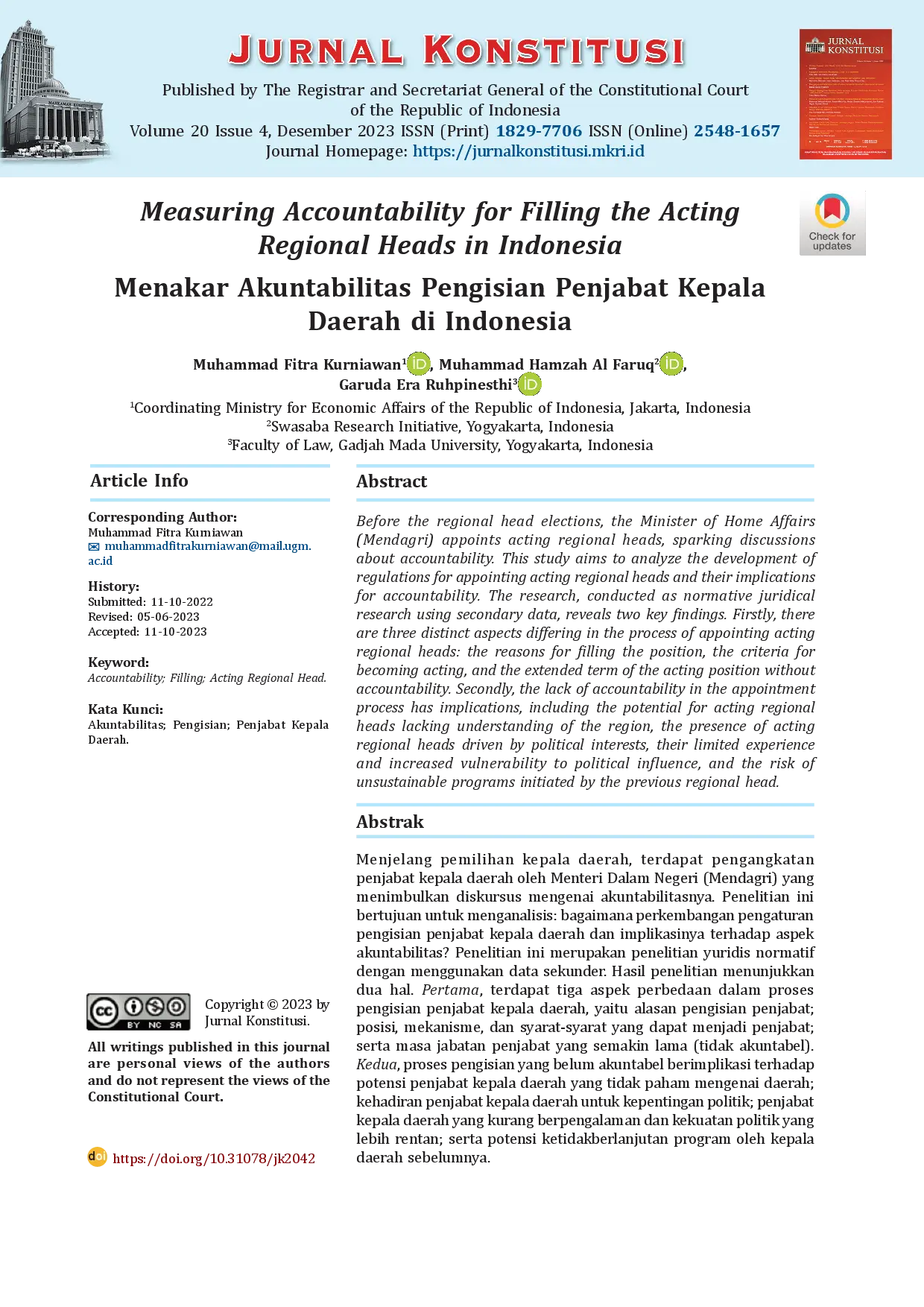
MKRIMKRI Menjelang pemilihan kepala daerah, terdapat pengangkatan penjabat kepala daerah oleh Menteri Dalam Negeri (Mendagri) yang menimbulkan diskursus mengenaiMenjelang pemilihan kepala daerah, terdapat pengangkatan penjabat kepala daerah oleh Menteri Dalam Negeri (Mendagri) yang menimbulkan diskursus mengenai
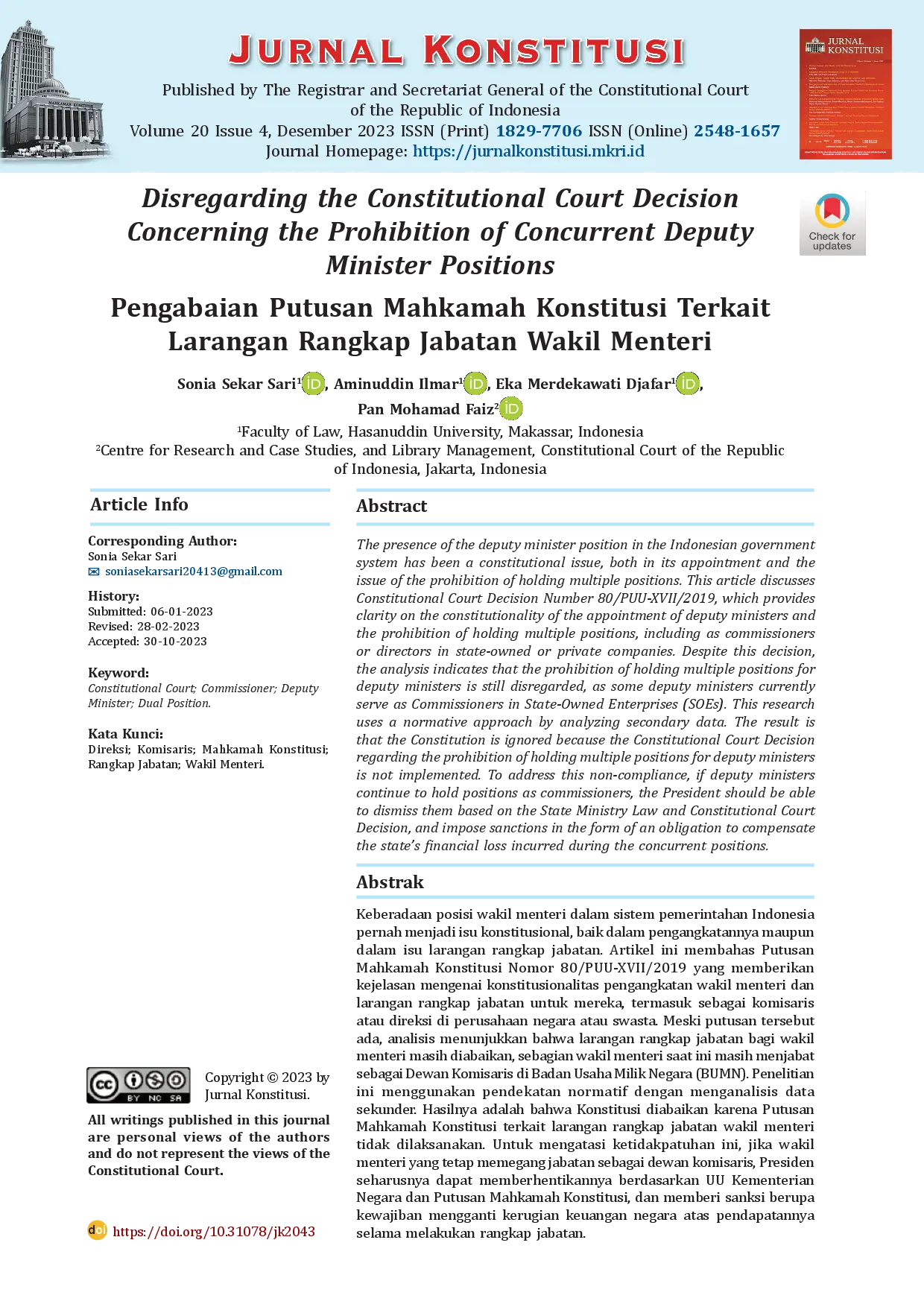
MKRIMKRI Hasilnya adalah bahwa Konstitusi diabaikan karena Putusan Mahkamah Konstitusi terkait larangan rangkap jabatan wakil menteri tidak dilaksanakan. UntukHasilnya adalah bahwa Konstitusi diabaikan karena Putusan Mahkamah Konstitusi terkait larangan rangkap jabatan wakil menteri tidak dilaksanakan. Untuk

IAIN GORONTALOIAIN GORONTALO Regarding textbook evaluation, this article aims to investigate teachers perspectives on textbook of curriculum 2013 or K13 for the second grade. EighteenRegarding textbook evaluation, this article aims to investigate teachers perspectives on textbook of curriculum 2013 or K13 for the second grade. Eighteen

UNIPASUNIPAS This influence was 59 percent, indicating a causal relationship between the activity and welfare. The study highlights the importance of effective reformulationThis influence was 59 percent, indicating a causal relationship between the activity and welfare. The study highlights the importance of effective reformulation
Useful /

LAKPESDAMSALATIGALAKPESDAMSALATIGA Analisis dilakukan secara deduktif dengan menurunkan prinsip umum kewarisan dan definisi tirkah, lalu mengujinya pada karakteristik dana pensiun yang bersifatAnalisis dilakukan secara deduktif dengan menurunkan prinsip umum kewarisan dan definisi tirkah, lalu mengujinya pada karakteristik dana pensiun yang bersifat

STIECENDEKIAKUSTIECENDEKIAKU Implikasi praktis: pemilik dan penyewa mendapatkan dasar penetapan sewa yang lebih transparan serta saran agar penilaian dilakukan berkala mengikut dinamikaImplikasi praktis: pemilik dan penyewa mendapatkan dasar penetapan sewa yang lebih transparan serta saran agar penilaian dilakukan berkala mengikut dinamika

HTPHTP Strategi epidemiologi merupakan lintasan untuk mencapai 3 tujuan epidemiologi. Tujuan makalah ini untuk menunjukkan inovasi bagaimana strategi epidemiologiStrategi epidemiologi merupakan lintasan untuk mencapai 3 tujuan epidemiologi. Tujuan makalah ini untuk menunjukkan inovasi bagaimana strategi epidemiologi

UNRUNR Kegiatan dilatarbelakangi oleh kebutuhan akan pemahaman yang mendalam terkait perencanaan tata ruang dan tantangan transformasi Mangupura dari wilayahKegiatan dilatarbelakangi oleh kebutuhan akan pemahaman yang mendalam terkait perencanaan tata ruang dan tantangan transformasi Mangupura dari wilayah