RADJAPUBLIKARADJAPUBLIKA
International Journal of Economic, Business, Accounting, Agriculture Management and Sharia Administration (IJEBAS)International Journal of Economic, Business, Accounting, Agriculture Management and Sharia Administration (IJEBAS)The Influence of Financial Knowledge and Personal Net Income on Financial Behaviour of Universitas Malikussaleh Employees with Locus Of Control as Moderation Variable. The purpose of this study was to determine how the model of financial behaviour of civil servants and lecturers in the Malikussaleh University environment and what factors are the most powerful in influencing the financial behaviour of employees in the Malikussaleh University campus environment. The research sample taken from the population in this study were 261 Civil Servants Group II to Group IV in Universitas Malikussaleh. The method used to support this research is quantitative method and in this study using multiple linear regression models. The processing and interpretation of research data using statistical software SmartPLS. The results of data analysis in this study indicate that financial knowledge has a positive and insignificant effect on the financial behaviour of Universitas Malikussaleh employees. Personal net income has a positive and significant effect on the financial behaviour of Universitas Malikussaleh employees. Locus of control does not moderate the effect of financial knowledge on financial behaviour of Universitas Malikussaleh employees. Locus of control does not moderate the effect of personal net income on the financial behaviour of Universitas Malikussaleh employees.
The study concludes that financial knowledge has a positive but insignificant impact on the financial behavior of employees at Malikussaleh University.Conversely, personal net income demonstrates a positive and significant influence on their financial behavior.Furthermore, locus of control does not significantly moderate the relationship between financial knowledge and financial behavior, nor does it moderate the relationship between personal net income and financial behavior.
Future research could explore the influence of behavioral biases, such as loss aversion or overconfidence, on the financial decisions of university employees. This could involve employing experimental designs or incorporating psychological scales to measure these biases. Additionally, investigating the role of financial education programs tailored to the specific needs of this population could provide valuable insights into improving financial well-being. Finally, a longitudinal study tracking the financial behaviors of employees over time, particularly in response to economic shocks or life events, would offer a more dynamic understanding of the factors influencing their financial choices and the effectiveness of interventions aimed at promoting responsible financial management. These studies should involve a larger and more diverse sample to enhance the generalizability of the findings and provide a more comprehensive understanding of the complex interplay between financial knowledge, income, psychological factors, and financial behavior among university employees.
| File size | 384.2 KB |
| Pages | 13 |
| DMCA | Report |
Related /

UNIKAMAUNIKAMA Rasio Efektivitas PAD consistently berada di atas 100% dengan rata-rata 103,74% yang menunjukkan target PAD realistis dan tercapai. Rasio Efisiensi BelanjaRasio Efektivitas PAD consistently berada di atas 100% dengan rata-rata 103,74% yang menunjukkan target PAD realistis dan tercapai. Rasio Efisiensi Belanja

UNIKAMAUNIKAMA Namun, dalam pelaksanaannya masih ditemukan berbagai permasalahan, seperti ketidakakuratan pencatatan stok, kelalaian dalam pengecekan barang, proses returNamun, dalam pelaksanaannya masih ditemukan berbagai permasalahan, seperti ketidakakuratan pencatatan stok, kelalaian dalam pengecekan barang, proses retur

UNIKAMAUNIKAMA Penelitian ini bertujuan untuk menganalisis persepsi pegawai terhadap efektivitas pembayaran gaji berbasis aplikasi SIM Gaji di Kemantren Gondomanan KotaPenelitian ini bertujuan untuk menganalisis persepsi pegawai terhadap efektivitas pembayaran gaji berbasis aplikasi SIM Gaji di Kemantren Gondomanan Kota
FEB UMIFEB UMI Penelitian selanjutnya direkomendasikan untuk mengeksplorasi faktor psikologis atau kontekstual lain yang mungkin memengaruhi perilaku manajemen keuangan.Penelitian selanjutnya direkomendasikan untuk mengeksplorasi faktor psikologis atau kontekstual lain yang mungkin memengaruhi perilaku manajemen keuangan.

UNPATTIUNPATTI Penelitian ini bertujuan untuk mengetahui pemanfaatan media sosial facebook dalam meningkatkan penjualan produk online shop cahaya store banda, denganPenelitian ini bertujuan untuk mengetahui pemanfaatan media sosial facebook dalam meningkatkan penjualan produk online shop cahaya store banda, dengan

UNTARUNTAR The research uses a quantitative methodology to collect primary data through a Google Forms-based questionnaire. The sample comprises 120 students withThe research uses a quantitative methodology to collect primary data through a Google Forms-based questionnaire. The sample comprises 120 students with
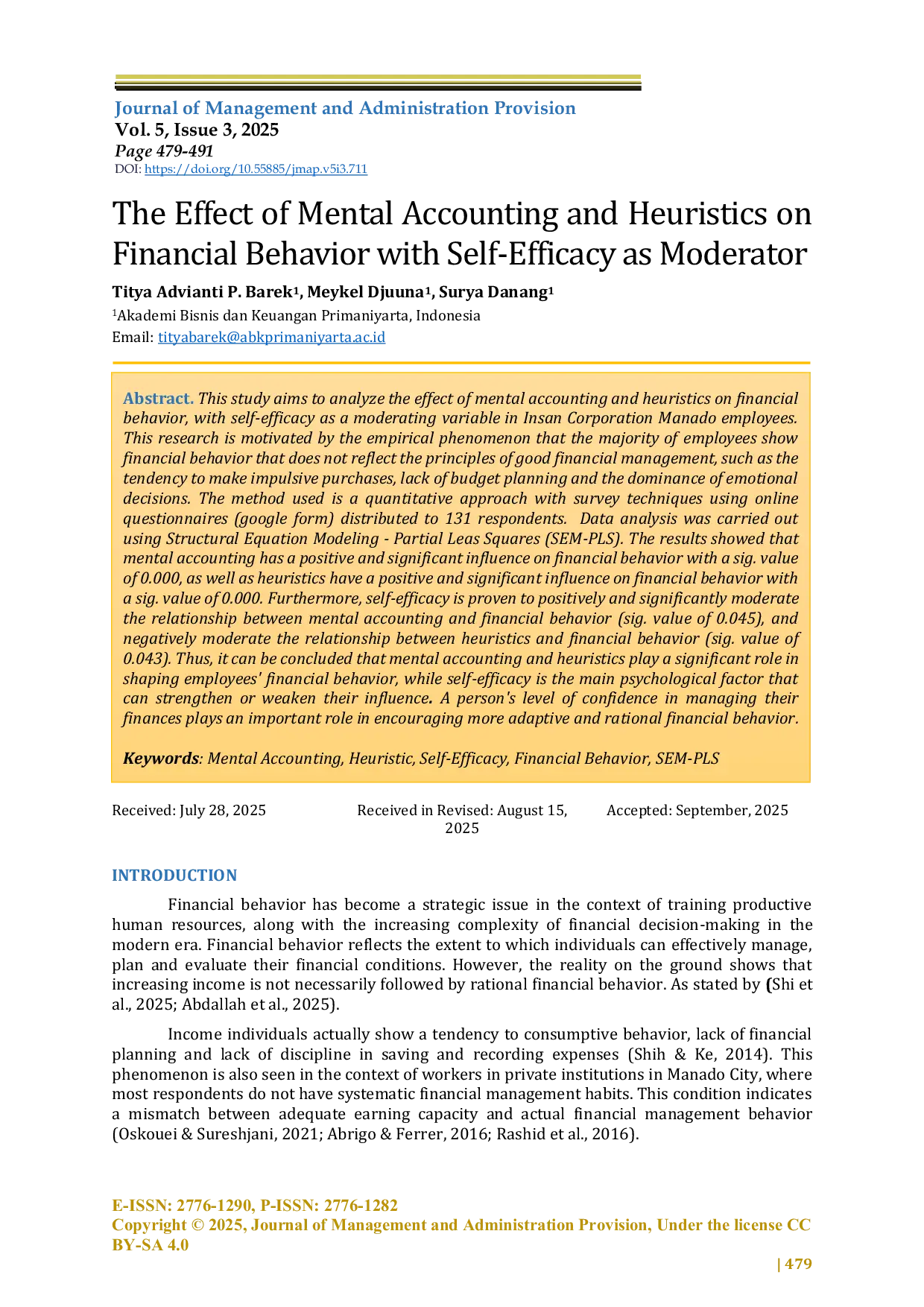
PSPPJOURNALSPSPPJOURNALS This study aims to analyze the effect of mental accounting and heuristics on financial behavior, with self-efficacy as a moderating variable in Insan CorporationThis study aims to analyze the effect of mental accounting and heuristics on financial behavior, with self-efficacy as a moderating variable in Insan Corporation

IAIN SUIAIN SU Metode penelitian ini menggunakan pendekatan kualitatif dimana penelitian ini menggambarkan dan menjelaskan serta menginterprestasi objek dengan apa adanya.Metode penelitian ini menggunakan pendekatan kualitatif dimana penelitian ini menggambarkan dan menjelaskan serta menginterprestasi objek dengan apa adanya.
Useful /

UNIKAMAUNIKAMA Penelitian ini menggunakan pendekatan kuantitatif serta metode kausalitas. Tujuan penelitian ini untuk menilai seberapa jauh kepemilikan manajerial danPenelitian ini menggunakan pendekatan kuantitatif serta metode kausalitas. Tujuan penelitian ini untuk menilai seberapa jauh kepemilikan manajerial dan

UNIKAMAUNIKAMA Studi ini bertujuan menganalisis pengaruh intensitas modal, pertumbuhan penjualan, intensitas persediaan, dan kompensasi rugi fiskal terhadap agresivitasStudi ini bertujuan menganalisis pengaruh intensitas modal, pertumbuhan penjualan, intensitas persediaan, dan kompensasi rugi fiskal terhadap agresivitas

UNIKAMAUNIKAMA Penelitian ini membahas perhitungan pajak gaji karyawan dengan menggunakan penghasilan bruto sebagai dasar perhitungan, yang meliputi gaji pokok, tunjangan,Penelitian ini membahas perhitungan pajak gaji karyawan dengan menggunakan penghasilan bruto sebagai dasar perhitungan, yang meliputi gaji pokok, tunjangan,

UNIKAMAUNIKAMA Berdasarkan hasil di atas ditemukan bahwa ROE berpengaruh terhadap nilai saham hal ini tercermin karena ROE dapat menunjukkan kemampuan perusahaan atasBerdasarkan hasil di atas ditemukan bahwa ROE berpengaruh terhadap nilai saham hal ini tercermin karena ROE dapat menunjukkan kemampuan perusahaan atas