PNLPNL
Jurnal PolimesinJurnal PolimesinThe development of biodegradable plastics offers a sustainable alternative to conventional ones, reducing environmental impact. This research focuses on the fabrication and characterization of biodegradable plastic films derived from large-leafed mangrove (Bruguiera gymnorrhiza) starch, chitosan, and clove essential oil (CEO) as an antioxidant additive. Glycerol was used as a plasticizer, while carboxymethyl cellulose (CMC) and carrageenan were incorporated as thickeners. The effects of glycerol (2.7–9 ml), chitosan (4–6% m/m), and CEO (0–8% m/m) concentrations on mechanical properties, morphology, and biodegradability were examined. Fourier-transform infrared spectroscopy confirmed the successful incorporation of chitosan and CEO. Scanning electron microscopy (SEM) revealed surface roughness and cavities due to incomplete chitosan dissolution. The optimized formulation (3% starch, 5 ml glycerol, 5% chitosan, and 5% CEO) exhibited superior mechanical properties, with a tensile strength of 710.98 MPa, Youngs modulus of 582.65 MPa, and elongation at break of 121.4%. Soil burial tests demonstrated complete degradation within 14 days. These findings highlight the potential of mangrove starch-based bioplastics for food packaging and eco-friendly applications.
This research successfully developed biodegradable plastic films from mangrove starch, chitosan, and clove essential oil.The optimized formulation demonstrated promising mechanical properties and a rapid degradation rate in soil.These findings suggest the potential of mangrove-derived bioplastics as a sustainable alternative to conventional plastics for applications like food packaging.Further research should focus on optimizing material blending techniques and exploring industrial scalability for commercial production.
Based on the findings of this study, future research could explore the use of different mangrove species to assess their starch properties and suitability for bioplastic production. Investigating the impact of varying concentrations of clove essential oil on the antioxidant activity and long-term stability of the bioplastic films is also crucial. Furthermore, research should focus on scaling up the production process and evaluating the economic feasibility of mangrove starch-based bioplastics compared to existing biodegradable alternatives. This includes assessing the environmental impact of large-scale mangrove starch extraction and the potential for integrating this bioplastic production into a circular economy framework. Finally, exploring the potential of combining mangrove starch with other biopolymers to enhance its mechanical properties and broaden its application range would be a valuable avenue for future investigation.
- Chemical modification of Chitosan for metal ion removal - Arabian Journal of Chemistry. chemical modification... arabjchem.org/chemical-modification-of-chitosan-for-metal-ion-removalChemical modification of Chitosan for metal ion removal Arabian Journal of Chemistry chemical modification arabjchem chemical modification of chitosan for metal ion removal
- Adsorption Properties of Essential Oils on Polylactic Acid Microparticles of Different Sizes. adsorption... mdpi.com/1996-1944/15/19/6602Adsorption Properties of Essential Oils on Polylactic Acid Microparticles of Different Sizes adsorption mdpi 1996 1944 15 19 6602
| File size | 640.41 KB |
| Pages | 8 |
| DMCA | Report |
Related /
AKBIDHIPEKALONGANAKBIDHIPEKALONGAN Hasil pengabdian masyarakat menunjukkan dari 30 peserta, sebagian besar peserta sebelum edukasi yaitu 21 peserta (70,0%) kategori baik, dan sesudah edukasiHasil pengabdian masyarakat menunjukkan dari 30 peserta, sebagian besar peserta sebelum edukasi yaitu 21 peserta (70,0%) kategori baik, dan sesudah edukasi

CEREDINDONESIACEREDINDONESIA Penelitian ini menyimpulkan bahwa Analisis SDM memiliki peran penting dalam meningkatkan kinerja berkelanjutan perusahaan perkebunan di Sumatera Utara.Penelitian ini menyimpulkan bahwa Analisis SDM memiliki peran penting dalam meningkatkan kinerja berkelanjutan perusahaan perkebunan di Sumatera Utara.
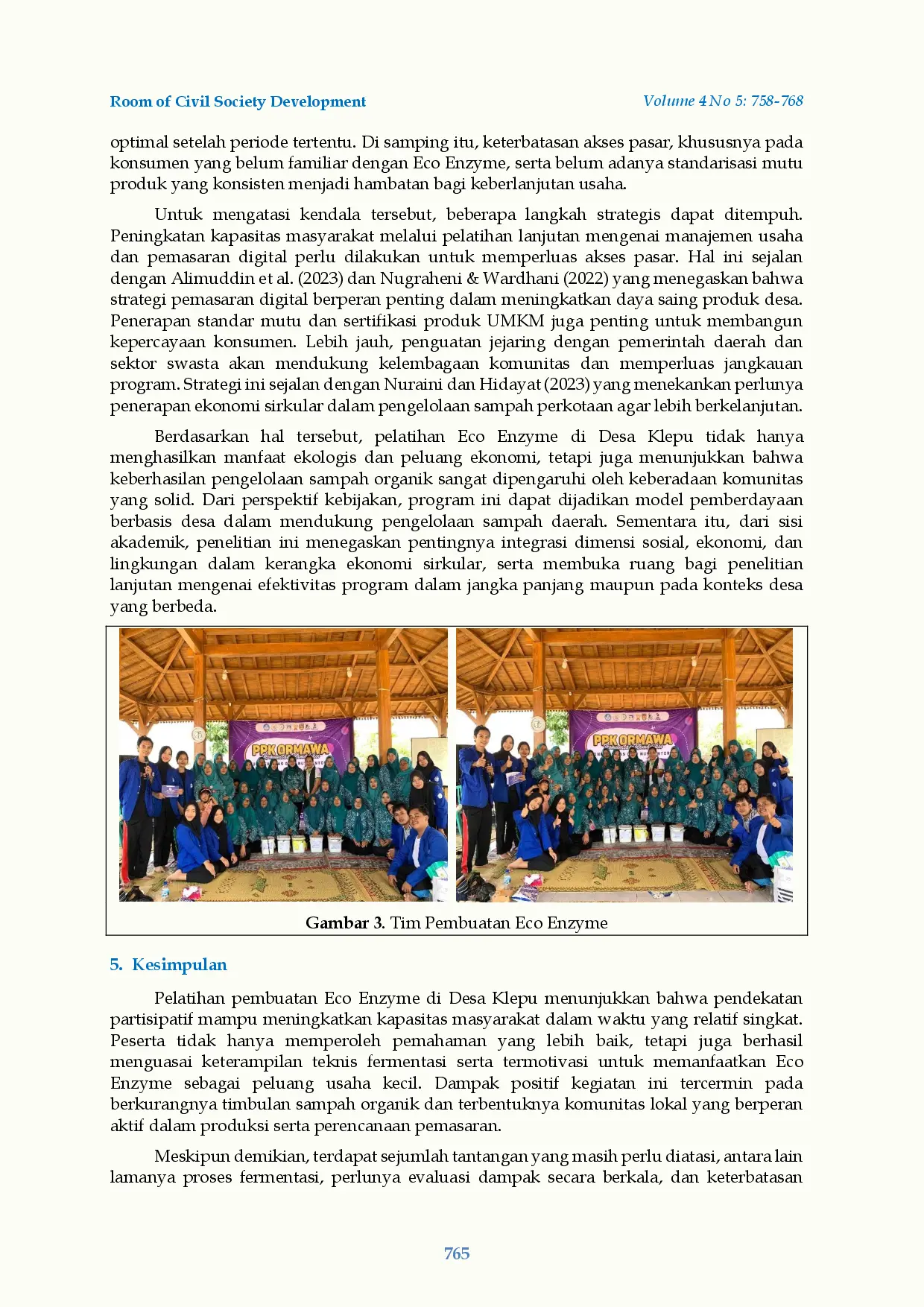
RCSDEVELOPMENTRCSDEVELOPMENT Dampak sosial terlihat dari terbentuknya komunitas produksi lokal dengan inisiatif merek EnzimKlepu, serta adanya rencana tindak lanjut berupa pelatihanDampak sosial terlihat dari terbentuknya komunitas produksi lokal dengan inisiatif merek EnzimKlepu, serta adanya rencana tindak lanjut berupa pelatihan
RCSDEVELOPMENTRCSDEVELOPMENT Oleh karena itu, asesmen non‑kognitif direkomendasikan menjadi bagian integral dalam sistem pendidikan madrasah, khususnya di daerah dengan keterbatasanOleh karena itu, asesmen non‑kognitif direkomendasikan menjadi bagian integral dalam sistem pendidikan madrasah, khususnya di daerah dengan keterbatasan
RCSDEVELOPMENTRCSDEVELOPMENT Produk yang dihasilkan tidak hanya berfungsi sebagai agen antibakteri, tetapi juga memberikan nilai tambah ekonomi dan lingkungan. Temuan ini menegaskanProduk yang dihasilkan tidak hanya berfungsi sebagai agen antibakteri, tetapi juga memberikan nilai tambah ekonomi dan lingkungan. Temuan ini menegaskan
RCSDEVELOPMENTRCSDEVELOPMENT Meskipun kegiatan ini tidak melibatkan pengukuran kuantitatif, sosialisasi terbukti menjadi langkah awal yang signifikan dalam memperkuat kapasitas masyarakatMeskipun kegiatan ini tidak melibatkan pengukuran kuantitatif, sosialisasi terbukti menjadi langkah awal yang signifikan dalam memperkuat kapasitas masyarakat

UNIGRESUNIGRES Hasil penelitian menunjukkan bahwa perlindungan hukum normatif telah diatur dalam UU Kesehatan 2023 dan UU Rumah Sakit, namun implementasinya masih lemah.Hasil penelitian menunjukkan bahwa perlindungan hukum normatif telah diatur dalam UU Kesehatan 2023 dan UU Rumah Sakit, namun implementasinya masih lemah.

UNISKA BJMUNISKA BJM Hasil dari penelitian ini mengindikasikan adanya korelasi antara tingkat kebersihan pribadi dengan insiden kasus scabies (p-value = 0,000), ada hubunganHasil dari penelitian ini mengindikasikan adanya korelasi antara tingkat kebersihan pribadi dengan insiden kasus scabies (p-value = 0,000), ada hubungan
Useful /
RCSDEVELOPMENTRCSDEVELOPMENT Oleh karena itu, pendekatan ini direkomendasikan untuk diintegrasikan secara berkelanjutan dalam kurikulum sekolah dengan dukungan kolaborasi lintas sektorOleh karena itu, pendekatan ini direkomendasikan untuk diintegrasikan secara berkelanjutan dalam kurikulum sekolah dengan dukungan kolaborasi lintas sektor

IJBE RESEARCHIJBE RESEARCH While government support policies and market competitiveness play a role, their impact is less pronounced than internal factors. Therefore, prioritizingWhile government support policies and market competitiveness play a role, their impact is less pronounced than internal factors. Therefore, prioritizing
MAHADEWAMAHADEWA Serta didukung dengan hasil tanggapan siswa pada skor rata-rata sebesar 43,78 dan berada pada kategori positif. Dari hasil yang didapat penulis memilikiSerta didukung dengan hasil tanggapan siswa pada skor rata-rata sebesar 43,78 dan berada pada kategori positif. Dari hasil yang didapat penulis memiliki

MAHADEWAMAHADEWA Berdasarkan hasil analisis data, diperoleh simpulan bahwa aktivitas siswa dan hasil belajar siswa meningkat yang dapat dilihat dari indikator: siswa yangBerdasarkan hasil analisis data, diperoleh simpulan bahwa aktivitas siswa dan hasil belajar siswa meningkat yang dapat dilihat dari indikator: siswa yang