ZAMRONEDUZAMRONEDU
JOELI: Journal of Educational and Learning InnovationJOELI: Journal of Educational and Learning InnovationThis qualitative descriptive research aims to examine the errors students make when solving quadratic function problems, focusing on their learning styles and the Newman procedure. The study targeted grade X-H students of MAN Surabaya, selected through purposive sampling. The research employed learning style questionnaires, math tests, and interview guidelines as instruments. The findings revealed five stages of errors in solving the test based on Newmans procedural error analysis, with the following contributing factors: (a) Reading errors: Students often rush and are careless when reading questions, a tendency seen in learning styles; (b) Misunderstanding: Students fail to accurately identify what is given and what is asked due to prior mistakes, commonly observed; (c) Transformation errors: Students struggle to understand the material and misuse formulas, frequently occurring among kinesthetics learners; (d) Process skill errors: Mistakes in applying steps to use formulas correctly, often stemming from earlier errors, observed across auditory, visual, and kinesthetics learners; and (e) Final answer errors: Mistakes in writing results, influenced by prior errors, also affecting auditory, visual, and kinesthetics learners.
Based on the results and discussion, it can be concluded that students in class X-H MA Negeri Surabaya make mistakes in solving quadratic function problems at five stages.reading, comprehension, transformation, process skills, and writing the final answer.The biggest mistake occurs at the final answer stage, while the smallest is at the reading and comprehension stages.These errors are influenced by learning styles and prior mistakes, with reading errors, misunderstanding, transformation errors, process skill errors, and final answer errors being identified as key contributing factors.
Further research could investigate the effectiveness of differentiated instruction tailored to individual learning styles in addressing these specific error patterns. Additionally, a study exploring the impact of targeted interventions focusing on Newmans procedural stages – particularly reading comprehension and transformation – could provide valuable insights into improving student performance. Finally, research could examine the correlation between students self-reported learning styles and their actual performance on different types of quadratic function problems, potentially revealing discrepancies and informing more accurate learning style assessments. These investigations should involve a larger sample size across diverse educational settings to enhance the generalizability of the findings and contribute to the development of more effective mathematics teaching strategies. The implementation of these studies could lead to a more nuanced understanding of student errors and the creation of personalized learning experiences that cater to individual needs, ultimately fostering greater success in mathematics education. Such research is crucial for equipping educators with the tools and knowledge necessary to address the challenges students face in mastering quadratic functions and other complex mathematical concepts.
| File size | 611.55 KB |
| Pages | 14 |
| DMCA | Report |
Related /

UYPUYP Program ini berhasil meningkatkan proses dan hasil dalam penyelenggaraan jenazah dengan metode explicit instruction, yang dibuktikan dengan semangat siswaProgram ini berhasil meningkatkan proses dan hasil dalam penyelenggaraan jenazah dengan metode explicit instruction, yang dibuktikan dengan semangat siswa

UYPUYP Melalui pendekatan pendampingan masyarakat dengan pendekatan pengembangan masyarakat, hasil dari proses pendampingan ini mampu memaksimalkan lahan sempitMelalui pendekatan pendampingan masyarakat dengan pendekatan pengembangan masyarakat, hasil dari proses pendampingan ini mampu memaksimalkan lahan sempit

UYPUYP Upaya memperkuat peran keluarga diharapkan menjadi gerakan baru dalam menangani masalah sosial, khususnya bantuan bagi anak-anak yang traumatik. ProgramUpaya memperkuat peran keluarga diharapkan menjadi gerakan baru dalam menangani masalah sosial, khususnya bantuan bagi anak-anak yang traumatik. Program

UYPUYP Masyarakat juga memperoleh pelatihan dalam kemasan produk, standar SNI, dan pemasaran secara daring yang mendukung pengembangan usaha mereka. Selain itu,Masyarakat juga memperoleh pelatihan dalam kemasan produk, standar SNI, dan pemasaran secara daring yang mendukung pengembangan usaha mereka. Selain itu,

UYPUYP Hasil pemeriksaan gula darah sewaktu menunjukkan 69,57% peserta belum pasti menderita DM, sedangkan sisanya tidak menderita DM. Kesimpulannya, terjadiHasil pemeriksaan gula darah sewaktu menunjukkan 69,57% peserta belum pasti menderita DM, sedangkan sisanya tidak menderita DM. Kesimpulannya, terjadi
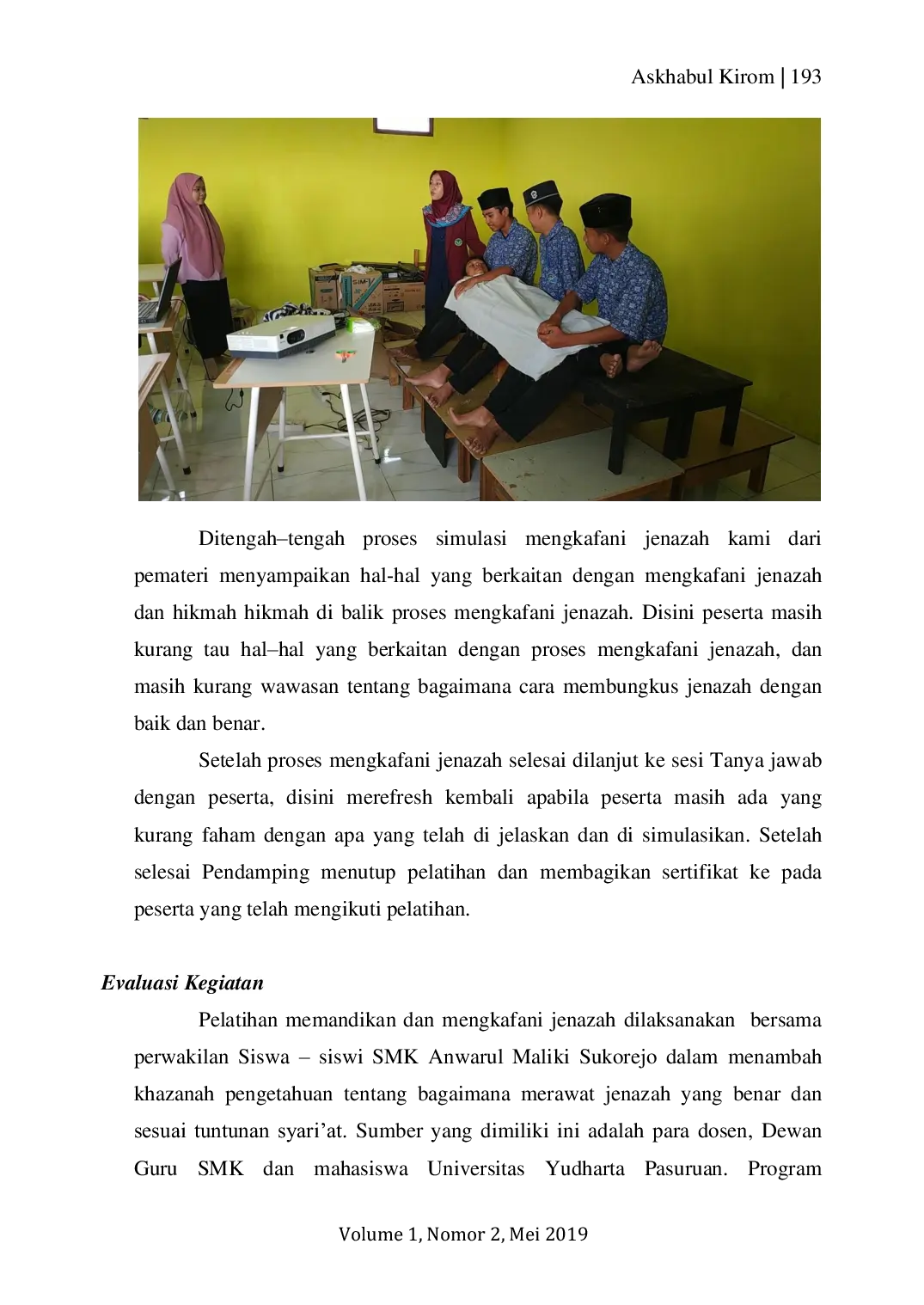
UYPUYP Berdasarkan hasil pelatihan Memandikan dan Mengkafani jenazah siswa-siswi SMK Anwarul Maliki dapat disimpulkan bahwa kegiatan pelatihan tersebut dinyatakanBerdasarkan hasil pelatihan Memandikan dan Mengkafani jenazah siswa-siswi SMK Anwarul Maliki dapat disimpulkan bahwa kegiatan pelatihan tersebut dinyatakan

UYPUYP Pelatihan ini juga mencakup packaging dan marketing untuk meningkatkan nilai jual produk. Kegiatan pendampingan ini berjalan lancar berkat dukungan berbagaiPelatihan ini juga mencakup packaging dan marketing untuk meningkatkan nilai jual produk. Kegiatan pendampingan ini berjalan lancar berkat dukungan berbagai

UYPUYP Selain itu, mitra program juga memiliki akun jual beli di marketplace seperti Bukalapak dan Shopee, serta media sosial Facebook dan Instagram. MelaluiSelain itu, mitra program juga memiliki akun jual beli di marketplace seperti Bukalapak dan Shopee, serta media sosial Facebook dan Instagram. Melalui
Useful /

ZAMRONEDUZAMRONEDU Tujuan dari kegiatan ini adalah untuk memperkuat kompetensi guru dalam pembelajaran diferensial. Pelatihan ini mendapat tanggapan positif dari kepala sekolahTujuan dari kegiatan ini adalah untuk memperkuat kompetensi guru dalam pembelajaran diferensial. Pelatihan ini mendapat tanggapan positif dari kepala sekolah

UYPUYP Produk kerupuk bungkil kedelai telah dipromosikan langsung oleh Kepala Desa Purwodadi kepada masyarakat, khususnya ibu-ibu PKK dan ibu rumah tangga yangProduk kerupuk bungkil kedelai telah dipromosikan langsung oleh Kepala Desa Purwodadi kepada masyarakat, khususnya ibu-ibu PKK dan ibu rumah tangga yang

UYPUYP KTI Probolinggo with TPST Al-Huda which is based on the principle of achieving environmental excellence which is carried out by creating shared valuesKTI Probolinggo with TPST Al-Huda which is based on the principle of achieving environmental excellence which is carried out by creating shared values

BAWASLUBAWASLU Penulis memberikan saran untuk kepastian hukum agar ketentuan mengenai pengujian putusan DKPP oleh PTUN dan makna putusan DKPP final dan mengikat dijelaskanPenulis memberikan saran untuk kepastian hukum agar ketentuan mengenai pengujian putusan DKPP oleh PTUN dan makna putusan DKPP final dan mengikat dijelaskan